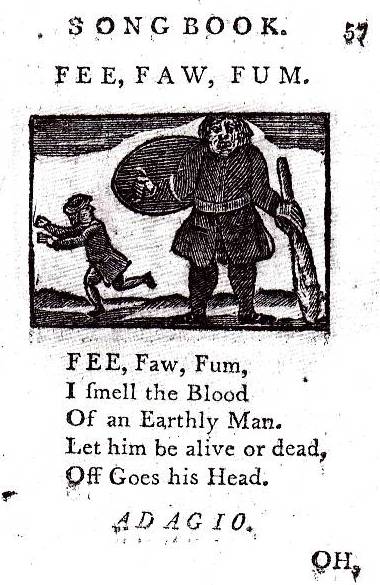
 This incomprehensible phrase is most famous for appearing in "Jack the Giant Killer." Most versions adhere to basically the same model:
Fee-fi-fo-fum I smell the blood of an Englishman. Be he alive or be he dead I'll grind his bones to make my bread. What does "fee-fi-fo-fum" actually mean? Nobody knows. Although there have been theories. (Does fie mean a cry of disapproval, as in "Fie! Fie!"? Or does it come from the Gaelic word for "tasty"? I'm leaning towards "neither, just a nonsense phrase.") When Thomas Nashe mentioned it in Have with you to Saffron-walden (1596), it was already an old saying of obscure origin. "O, tis a precious apothegmatical Pedant, who will find matter enough to dilate a whole day of the first invention of Fy, fa, fum, I smell the blood of an English-man". (I have to say, I love that paragraph.) It also appears in King Lear (1605): Child Roland to the dark tower came, His word was still, Fie, foh, and fum, I smell the blood of a British man. In 1814, Robert Jamieson's version of Childe Rowland in Illustrations of Northern Antiquities had the Elf-king proclaim, "With fi, fi, fo, and fum! I smell the blood of a Christian man! Be he dead, be he living, wi' my brand I'll clash his harns frae his harn-pan! " [I'll dash his brains from his brain-pan] And in Tom Thumb (1621) - on this blog you know it's always going to come back to Tom Thumb - the hero encounters a giant who says, Now fi, fee, fau, fan, I feele smell of a dangerous man, Be he alive, or be he dead, He grind his bones to make me bread. So, by 1621, the rhyme was already associated with giants, and the colorfully gruesome idea of bone-meal bread was in existence. (Tom Thumb, as well as being the first fairytale printed in English, has lots of common fairy tale tropes, such as the fairy godmother.) So the phrase fee-fi-fo-fum has been around a long time. It first appeared in print in combination with Jack the Giant Killer when that story was printed in 1711. Regarding Childe Rowland, Jamieson recalled hearing a version in his childhood from a tailor: "the tailor curled up his nose, and sniffed all about, to imitate the action which "fi, fi, fo, fum!" is intended to represent." So maybe "fee fi fo fum" is meant to be some kind of onomatopoeia for smelling? I don't know how that would work, but I do find the different variations interesting. It looks like it was once more common to have only three syllables instead of four. Although this phrase is English, there are parallels to monsters detecting people by the smell of their blood in other countries. In Perrault's Popular Tales, Andrew Lang connects this theme to the Furies in Aseschylus' Eumenides.
2 Comments
If you're a fan of King Lindworm and other beastly bridegroom tales, check out Jenny Prater's blog Halfway to Fairyland. I've been enjoying it.
Now, on to the analysis! Little Shell is a tale from the people of the Visayan Islands, one of the three main divisions of the Philippines. Retold by Elizabeth Hough Sechrist, it's a unique variation on the Thumbling tale, but still has many recognizable elements. The story begins like many thumbling stories. A man and a woman, after many prayers, have a son no bigger than a seashell. When he grows a little older, the boy - known as Little Shell - begs his mother to allow him to go out on his own and work. He crawls into a woman's fish basket and shouts, "Run! Run!" Thinking that her fish have been bewitched, the frightened woman runs off, allowing Little Shell to make his exit with one of her fish, which he takes home to his mother. He plays a similar trick on an old man carrying a cow's head (cow's heads have good meat on them). Hearing Little Shell shouting, the old man thinks that the cow's spirit has returned to haunt him, and flees. Little Shell asks his mother to go to the chief or headman, and request the hand of his daughter in marriage. Although the headman immediately refuses, his daughter agrees to the union. Shell's mother is astonished; the headman is furious, and Shell and the princess are forced to flee. They live together, but are unhappy in exile. However, after one week, Little Shell grows to normal size. It turns out he was enchanted by an evil spirit at birth, and the princess's love has broken the spell. They return home, the headman is ashamed of his behavior, and everyone lives happily ever after. Sechrist drew this story from "The Enchanted Shell," which appeared in Visayan Folk-tales, II, in the Journal of American Folk-Lore in 1907. These folktales were prepared by researchers Berton L. Maxfield and W. H. Millington during their stay in the Visayan Islands. They collected them in Spring 1904, on the island of Panay. Teachers and students at schools in Iloilo and Mandurriao contributed stories. "The Enchanted Shell" has some minor differences. Rather than telling the woman to "Run! Run!" Shell tells her "Rain! Rain!" There is also a specific location named - "a desert place called Cahana-an." Specific location names are always interesting. The phrasing is a little confusing; Maxfield and Millington's Shell is "very small, and just like a shell," and at some points he's referred to simply as "the shell." It seems Sechrist adapted this as she felt best. However, thumbling characters can be small animals or objects. The enchanted shell does several things typical to a thumbling story. He's born as the result of a hasty wish; he goes out to do work despite his small size; he's a trickster; he climbs into an animal's ear. It's possible some aspects of this story came from European colonizers. I do think it's important to note that Maxfield and Millington say that all of the stories they published were very widespread in the Visayan islands, and everyone seemed to know them. The revelation about an enchantment seems to come from nowhere, almost as if there's a part of the tale which has been lost. The romance plot, on the other hand, reminds me of Issun-Boshi and the Japanese family of thumbling tales. Japan and the Philippines have had relations for centuries, with trading going back at least to the 1600s and to the Muromachi period. Issun-Boshi and Little Shell could perhaps share roots. The Living Head, another Visayan tale, is very similar - at least at the beginning. Here, the childless couple produces not a shell or a tiny baby, but a disembodied head. The head, imaginatively named Head, sees the chief's daughter and falls in love with her. He sends his mother to ask for the princess's hand in marriage. Like Little Shell and his mother, they argue back and forth, but the mother finally goes to ask the chief. However, in this case, she gets a solid no. When Head hears the news, he begins to sink into the ground. His mother calls him to dinner, but he only cries, "Sink! Sink! Sink!" He disappears into the ground, and from that spot grows the first orange tree. A final relevant tale from the Philippines is the Bagobo tale "The Woman and the Squirrel." The Bagobo people live in southeastern Mindanao. This story was collected in 1907; collector Laura Watson Benedict noted that the myths were specifically those that hadn't been recorded yet, they were told in mixed English and Bagobo, and they were collected from "Mount Merar in the district of Talun, and at Santa Cruz on the coast." A woman drinks some water from a leaf. She goes home and falls asleep for nine days, and when she wakes up and begins to comb her hair, a baby squirrel emerges from it. This type of unusual conception is not unusual in fairytales (see Nang Ut and the Miraculous Birth). The squirrel grows to maturity and a week, and tells his mother that he wants to marry the chief's daughter. Despite her protests, he sends her off to the chief's house with nine necklaces and nine rings as a dowry. She chickens out and comes back without asking, so the squirrel bites her (!). Finally, she makes her request. In response, the chief tells her that he wants his entire house turned to gold. She relays this to her son the squirrel. That night, the squirrel goes out and calls to his brother, the Mouse. The "great Mouse" has golden fur, and his eyes are glass. He gives the squirrel a bit of his fur, which the squirrel uses to turn the sultan's house and possessions completely into gold. When the chief wakes up and sees that his impossible request has been granted, he dies of shock. The squirrel then marries the princess, and after a year, he takes off his skin and becomes a handsome young man. "The Enchanted Shell," "The Living Head," and "The Woman and the Squirrel" form a tale family of their own, with a romantic aspect that runs through all three stories. A woman gives birth to a small and monstrous son, who sets out to marry the daughter of a chief. Whether he succeeds or not - that's another story. Another thumbling figure from the Philippines is Carancal, a Young Giant-type character who is born only one span tall. That, however, is a very different tale. Resources
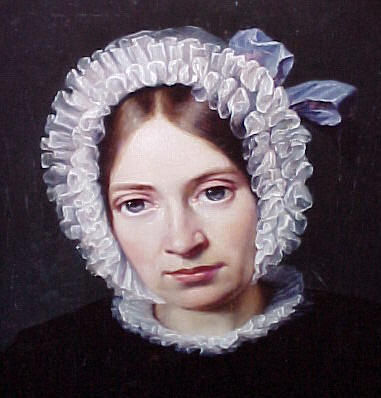 Henriette Wulff as a young woman Thumbelina, or Tommelise, was first published in 1835. An author may be inspired by many things, not all of them obvious. One theory is that the character of Thumbelina was inspired by a close friend of Hans Christian's Andersen's: Hanne Henriette Wulff, known to friends as Jette (1804 -1858). Andersen considered the Wullfs close family friends. The oldest daughter of the family, Henriette was tiny, frail, and slightly hunchbacked. She became one of Andersen's most faithful penpals, and their letters are one of the main sources of information about his life. She also helped translate some of his work to English. They seem to have had a close platonic relationship, and Andersen would portray her in his autobiography as almost his muse. The theory that she inspired Thumbelina is seen in works such as Opie's Classic Fairy Tales (1974) and Houselander's Guilt (1951). Many of Andersen's fairytales were inspired by older folklore, and there was a wealth of thumbling stories that he surely drew on for Thumbelina. Tom Thumb was famous, of course; there were also the Thumbling stories of the Brothers Grimm collection, and Danish variants such as Tommeliden or Svend Tomling. Thumbelina's opening sequence, with the lonely woman longing for a child, could be straight out of one of these tales. There were plenty of other works containing tiny people which could have inspired Andersen. As listed by Diana and Jeffrey Frank, Andersen would have been familiar with Gulliver's Travels (1726), Micromégas by Voltaire (1752), and E.T.A. Hoffmann's works "Meister Floh" (1822) and "Prinzessin Brambilla" (1820). The image of a tiny girl also appeared in Andersen's previous work and first real literary success, A Journey on Foot from Holmen's Canal to the East Point of Amager (1828). According to the Franks, there is no evidence that Thumbelina was based on Henriette. They do suggest, however, that the character of the learned but literally and metaphorically blind mole was inspired by Andersen's former teacher, Simon Meisling. Meisling was a short, overweight man who apparently did look somewhat like a mole. He repeatedly told Andersen that he would never make it as an author, calling him a stupid boy. 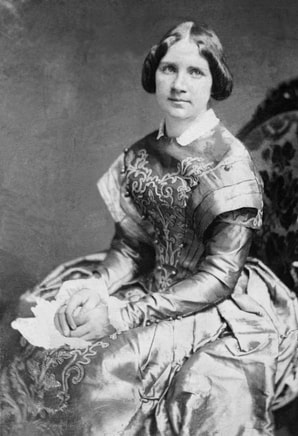 Jenny Lind SurLaLune also compares Thumbelina's beautiful singing voice to that of Andersen's friend, the famous singer Jenny Lind. Andersen and Lind met in 1843. In Hans Christian Andersen's Interest in Music, Gustav Hetsch and Theodore Baker assert that Lind inspired "The Nightingale," "The Angel," and "Beneath the Pillar." Another biographer, Carole Rosen, suggested in the Oxford Dictionary of National Biography that Lind inspired "The Ugly Duckling" and that her rebuffing of Andersen's affections influenced the icy-hearted Snow Queen. That last one is kind of a leap. The tale that is most likely connected to Lind is "The Nightingale." The Franks mention that right after Andersen saw her perform and visited Tivoli Gardens, which had an "Asian fantasy motif," he started the Nightingale and made note of it in his diary. He finished the story in two days (pg 139). Afterwards, as Lind grew world-famous, she was known by the nickname "The Swedish Nightingale." The Franks also say that Andersen's bleak tale "The Shadow" was aimed at a friend named Edvard Collin who had snubbed him years before (pg 16). 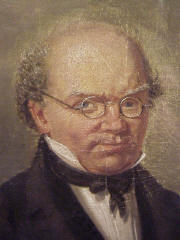 Simon Meisling Andersen undoubtedly drew on his experiences and the people around him for inspiration. It's entirely possible that aspects of the mole were inspired by Simon Meisling, some part of Thumbelina by Henriette Wulff, or the sweet song of the Nightingale by Jenny Lind. However, a lot of that has to remain speculation.
As for more on Henriette Wulff: she loved travelling and the sea, visiting such places as Italy, the West Indies, and the United States. After her parents' death, she lived with her brother until he died of yellow fever. She returned to Denmark, but strongly considered emigrating permanently to America, where her brother was buried. In 1858, she embarked for New York on the SS Austria. Twelve days after her departure, on September 13, there was an accident with fumigation equipment, and the ship's deck burst into flames. Passengers leaped into the sea to escape the roaring fire that engulfed the entire ship. Out of the 542 people aboard, 449 perished. Henriette was among the dead. In a poem dedicated to her, a grieving Andersen called her sister. Sources
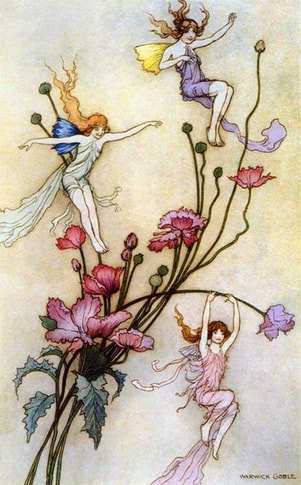 I have a few pages, including "The Little Folk," "List of Fairies," and "The Denham Tracts," related to fairy lore. They're a work in progress. I've found that sources are often hard to sort through. A small superstition from one area can easily bloat and transform into a supposedly famous Europe-wide tradition. Mistakes are repeated as fact until the real facts are forgotten. For one example: hyter sprites are mentioned in a few encyclopedias as small fairies with sand-colored skin and green eyes, who are protective of children and, most notably, can transform into sand martins. The most well-known source for these was Katherine Briggs' Encyclopedia of Faeries (1973), based on an account by folklorist Ruth Tongue. In 1984, Daniel Allen Rabuzzi wrote an article, “In Pursuit of Norfolk's Hyter Sprites," trying to chase down the original tradition. When he interviewed natives of Norfolk, he found no tradition of little werebird fairies. Instead, the phrase hyter, hikey or highty sprite was an idiom or nickname, most frequently used for a bogeyman ("Don't go out after dark or the hikey sprites will get you!") Everyone imagined them differently. One account described them as human-sized, batlike, threatening figures. Also, it turns out that although Ruth Tongue was a wonderful storyteller, she may have straight-up invented a lot of the stories she "collected." A class of fae similar to hyter sprites are "pillywiggins," tiny spring flower fairies in English and Welsh folklore. They have wings and antennae like insects. Though protective of their garden habitats, they are peaceful creatures who (unlike most fairies) don't bother much with humans or pranks. They live in groups, ride on bees, and their queen is named Ariel. At least, that's what you'd gather from the handful of books that mention them.
I should mention that many of these books are terrible at citations. Many of them don't cite anything, they just have one giant bibliography with no way to tell what came from where. Dubois's book is rife with misspellings, and Bane's with mistakes and misattributions. It looks like Dubois and McCoy were both elaborating on the brief description of Fairies & Elves, with very fanciful entries of their own. I have not found any supporting evidence for McCoy's "Queen Ariel." Here, McCoy actually seems to have cribbed from Shakespeare's Tempest (1610). McCoy's pillywiggins are bee-riding spring fairies, and her Queen Ariel "often rides bats, and is blonde and very seductive. She wears a thin, transparent garment of white, sleeps in a bed of cowslip, and can control the winds. She cannot speak, but communicates in beautiful song." Compare The Tempest, where a spirit named Ariel sings, Where the bee sucks, there suck I. In a cowslip’s bell I lie. There I couch when owls do cry. On the bat’s back I do fly After summer merrily. Merrily, merrily shall I live now Under the blossom that hangs on the bough. Still, later writers cited Dubois' and McCoy's work as folklore fact. Bane's encyclopedia of folklore and mythology has an entry on pillywiggins based on McCoy's description. Pillywiggin queen Ariel appears in the novels Buttercup Baby by Karen Fox (2001) and Alexander of Teagos by Paula Porter (2010). In 1986, a UK-published My Little Pony comic featured pillywiggins as non-winged flower fairies. It was apparently written for Wayne and Claire of Hanham, Bristol. 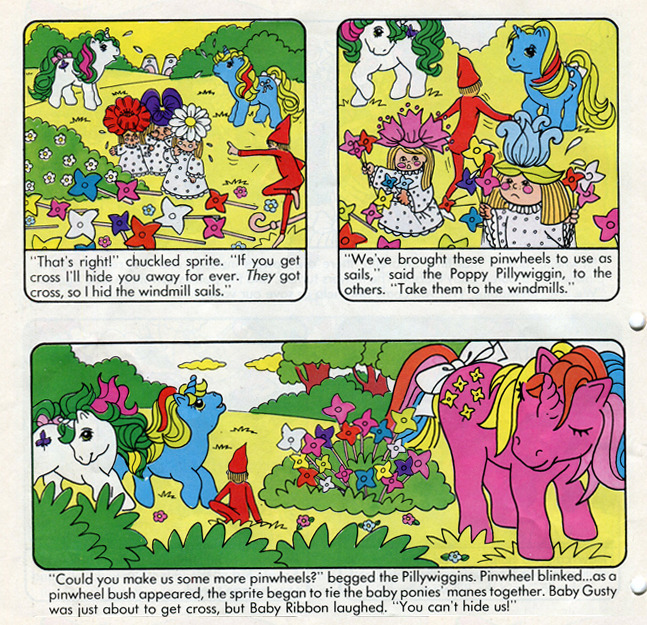 There is an extensive article on pillywiggins on the French Wikipedia. But these are supposed to be English fairies - why is there more on them in French than in English? Even the talk page raises questions about this, besides pointing out that all sources are very recent and do not point to pillywiggins being a part of tradition. The most recent edit, by Tsaag Valren on June 6, 2011 says, "...after a week of research, seeing that I could find nothing more, I asked Pierre Dubois himself how he got his sources. He told me broadly that he wrote from popular English songs and discussions. As for the other works on the fairies, in general they repeat themselves: pillywiggin is the fairy of flowers, and not much more!" Although they've gained a tiny foothold into literature, I have yet to find the word pillywiggin recorded in anything before the 1970s. This is in stark contrast to other British and Welsh fairies such as pixies and brownies, which were first described hundreds of years ago, and which have variations in many different places. There could certainly be an oral tradition of pillywiggins going way back, but in that area of the world, it seems unlikely that it would have escaped notice. I can only track the name itself back to Arrowsmith's Field Guide to the Little People. It mentions pillywiggins briefly, in a list of other tiny fairies, and says they're from Dorset. My research into Dorset folklore has not yet discovered any mention of pillywiggins. Arrowsmith's bibliography lacks details, so it's hard to say where she found this information. She also mentions Ruth Tongue's hyter sprites, which as already noted, have a shaky basis in folklore. However, there are plenty of traditions of fairies being related to oak trees and plants including bluebells, thyme and foxgloves. Oak trees have magical qualities in British lore, and there's an old poem with the line "Puck is busy in these oakes." Many other plants were named for fairies. Foxgloves in particular are often connected to fairies and witches. For instance, the Welsh ellyllon are “pigmy elves” who wear foxgloves on their hands. The idea of miniature fairies goes at least as far back as the description of the one-inch-tall portunes in Gervase of Tilbury's Otia Imperiale, around the year 1210. Around 1595, A Midsummer Night's Dream gave us fairies who have power over nature, crawl into acorn cups and hang the dew in flowers. In 1835, Hans Christian Andersen's Thumbelina emerged from a flowerbud and later encountered flower spirits with fly's wings. In the first half of the 20th century, Cicely Mary Barker's illustrations and Queen Mary's interests truly popularized the idea of tiny, benevolent flower fairies. As it happens, Pillywiggin does sound a lot like another fairy name: Pigwiggin or Pigwidgeon. You might recognize this word as the name of a pet owl in the Harry Potter series. It is a name for a tiny, insignificant creature. There are lots of different theories on its etymology, but Pigwiggin became famous as the name of a fairy knight in the 1627 poem Nymphidia. From there, pigwidgeon emerged as an obscure name for a miniature fairy or dwarf. The English Parnassus (1657, Josua Poole) includes a list of Oberon and Mab's courtiers, including "Periwiggin, Periwinckle, Puck." This is based on Nymphidia with some misspellings. This textual error could be an important clue. Maybe pillywiggin, like periwiggin, is just a misspelling of Pigwiggin. From there, it was picked up by other researchers and took on a life of its own. I will say that Pillywiggin is a fun name, and I don't really mind using it for the modern flower fairy. For the moment, my search has come to an end, but I will be keeping an eye out for further clues. If you have any insight on this subject, let me know! Further reading
Part 2: What are Pillywiggins? Revisited Part 3: Pillywiggins in Pop Culture Part 4: Pillywiggins, Etymology, and ... Knitting? Part 5: Diamonds and Opals: Two Romances Featuring Pillywiggins Part 6: Pillywiggins: An Amended Theory 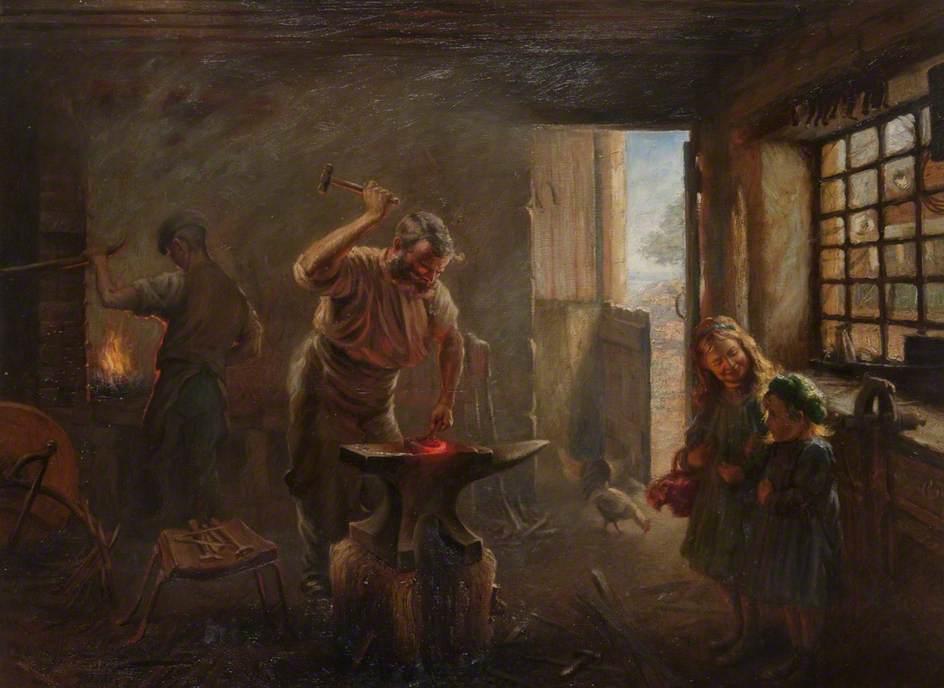 In a lot of modern stories, iron is fairies' kryptonite. Their silver bullet. All the hero has to do is whip out a cast-iron skillet, and evil sprites cower.
It's often explained as iron having natural anti-magic qualities, or symbolizing the march of industrialization and the fading of magic. Or any other of a billion explanations. For further confusion, it's not just iron. It's "cold" iron. The phrase can be baffling to modern readers, and for maximum confusion there actually is such a thing as cold-wrought iron. However, cold-wrought iron is newer than the phrase "cold iron," which in this case is poetic. "Cold steel" is the modern equivalent and simply means a weapon that to draws blood (Current Literature, 1891). Where did this originate? It's just one of those folkways that can never be sourced to any one person, and always seems to have been "well, everyone knows it." However, you can trace it back through history to an xtent. In Robert Herrick's "Another charme for stables" (1648), the reader is told to hang up metal hooks and shears to protect their horses from being ridden at night by witches. In 1691, Robert Kirk wrote that "The Tramontanes, to this day, put bread, the Bible, or a piece of iron, in womens bed" to prevent newborn children from being stolen by fairies; and "they commonly report, that all uncouth, unknown Wights are terrifyed by nothing earthly so much as by cold Iron." So the phrase and the tradition date back at least to the 1600's. The iron seems to be more popular than the bread as a popular way to repel fairies. I guess it's just not as exciting to send your hero into battle wielding a baguette. The superstition of leaving iron in the bed to prevent fairies kidnapping expectant mothers continued over the centuries. Thus, the way to protect children from being replaced by changelings was usually to leave open scissors, a knife, fire tongs, or a similar object near their cradle. Around 1850, in Northern mythology by Benjamin Thorpe, a story is related where a smith sees a troll kidnapping a pregnant woman. Since the smith is working at his forge, he uses a piece of red-hot iron to frighten off the troll. In other stories in the same volume, trolls and huldra seem to have no trouble with iron. And, like, most people don't want to be chased with red-hot iron. That's not just a magical creature thing. However, there is also a mention of a Danish tradition that "On the eve of Maundy Thursday the country folks cast axes and iron wedges on the sown fields, and fasten steel on all their doors, that the witches may not injure them." In the Ozarks, there were many traditions surrounding iron nails. They could be nailed into someone's footprint - either to hurt an enemy, or a witch. They could be used to prevent disease, or they could be driven into a doorframe, which was particularly effective in protecting (again) pregnant women from evil. These practices were recorded around 1947. So these superstitious practices surrounding iron are surprisingly long-lived. Right into the 20th century! On the other hand, they also go back further than I originally realized. In Natural History, Book XXXIV, Chapter 44, Pliny the Elder mentioned that iron was used both in medicine and in preventative magic. "Iron is employed in medicine for other purposes besides that of making incisions. For if a circle is traced with iron, or a pointed weapon is carried three times round them, it will preserve both infant and adult from all noxious influences: if nails, too, that have been extracted from a tomb, are driven into the threshold of a door, they will prevent night-mare." There is much more about iron and magnets besides this, but this quote alone establishes a history for iron as having magical protective properties. And that was around 79 AD! So at first, it was simply that iron could protect and heal people. Actually, some of the superstitions in Pliny - like iron having healing properties, or the idea of driving nails into a door - were still pretty current in the Ozarks almost 1900 years later. It's easy to see how it could go from "iron protects from evil" to "iron protects from sickness, evil spirits, witches, and fairies" which were all kind of interchangeable at that point. Many of the superstitions center around vulnerable groups, like pregnant women and small infants. A Victorian theory is that the first iron found was from meteorites, which would give it an otherworldly and sacred meaning as something that had fallen from the heavens. However, that's speculation. Iron is a hard and durable metal with the possibility of becoming magnetized. There are beliefs about it and evidence of it being used in amulets and charms for about as long as iron has existed. It was seen as pure or impure by different groups. There were quite a few superstitions surrounding blacksmiths, as well; blacksmiths having healing abilities or, in Scotland, being allowed to perform marriages; and there were gods who were smiths, like the Greek Hephaestus. There are more esoteric explanations, like iron being seen as the lifeforce of the earth, or associated with lifeforce because blood smells like iron. There are superstitions associated with every substance known to humankind. There are some negative superstitions associated with iron, too. This one just happens to be the most well-known. Further Reading
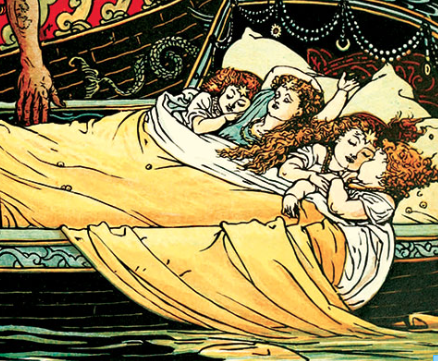 Princess Belle-Etoile and her siblings, with stars on their foreheads The person with a star, sun or moon on their face appears in several different tale types. However, depending on the tale, the details are a little baffling. What does having a star on your forehead even look like? Is it a literal star? Is it some kind of crown? Is it a birthmark shaped like a star?
The unusually-decorated girl appears in The Twelve Brothers (Germany), "The unnatural mother and the girl with a star on her forehead" (Mozambique), and The Maiden with the Rose on her Forehead (Portugual). In some versions of Aarne-Thompson-Uther type 850, "The Birthmarks of the Princess," she has birthmarks shaped like stars, suns, or moons. Sometimes, in the tale of "The Kind and Unkind Girls," the star is a reward given to a generous young woman. Her selfish and greedy sister receives horns, a donkey's tail, or some other ugly object on her forehead. I read one where it was a sausage. Examples of this variation include:
The last tale type that is well-known for the forehead-star is ATU type 707: The Three Golden Children. A woman gives birth to marvelous children, who have unusually shiny characteristics.
The star functions as a tangible sign of royalty and/or virtue. If a color is given, it is usually gold. Golden hair or skin can appear in similar roles, instantly marking someone as beautiful and extraordinary. FURTHER READING AARNE-THOMPSON MOTIFS
Most editions of the Tom Thumb fairytale end with the king erecting a monument in memory of the pint-sized hero. Here lies Tom Thumb, King Arthur's knight, Who died by a spider's cruel bite. He was well known in Arthur's court, Where he afforded gallant sport; He rode a tilt and tournament, And on a mouse a-hunting went. Alive he filled the court with mirth; His death to sorrow soon gave birth. Wipe, wipe your eyes, and shake your head And cry,--Alas! Tom Thumb is dead! In fact, there is a real tomb for Tom Thumb. There was once a blue flagstone serving as his tombstone at the Lincoln Cathedral. According to a 1819 edition of the Quarterly review, the tradition was that Tom Thumb died at Lincoln, and "the country folks never failed to marvel at [the blue flagstone] when they came to church on the Assize Sunday; but during some of the modern repairs which have been inflicted on that venerable building, the flag-stone was displaced and lost, to the great discomfiture of the holiday visitants." (The Quarterly Review, 1819, p101). Here is more on the renovations, although it has no mention of the flagstone. What we do still have is a tombstone and a house for Tom Thumb, roughly twenty miles away, in Tattershall, Lincolnshire. 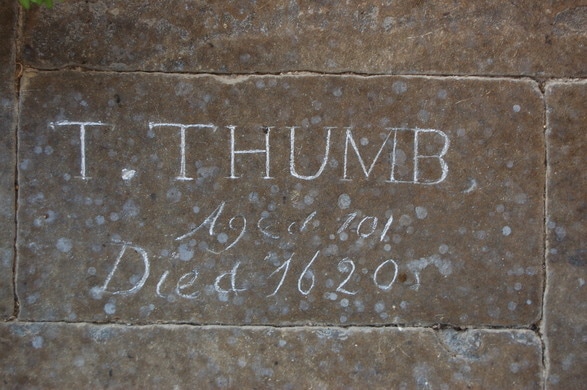 "T. Thumb, Aged 101, Died 1620." Is there really someone buried under this marker? Could he be connected to the fairytale? The tombstone is located in the Holy Trinity Collegiate Church and can be found in the floor, near the font. The website of an affiliated church group notes that this Tom Thumb was "47 cm tall" or about 18.5 inches. An Atlas Obscura article cites rumors that he frequently visited London and was a favorite of the King. The date of 1620 is intriguing, because it puts this local legend of Tom Thumb right about the same time we have our first surviving textual mentions of the name - the grave is marked 1620, and the earliest known printing of Tom Thumb was in 1621. (See the Tom Thumb Timeline.) The grave is usually seen decorated with flowers and a poem. Here is an excellent shot from the Atlas Obscura article. 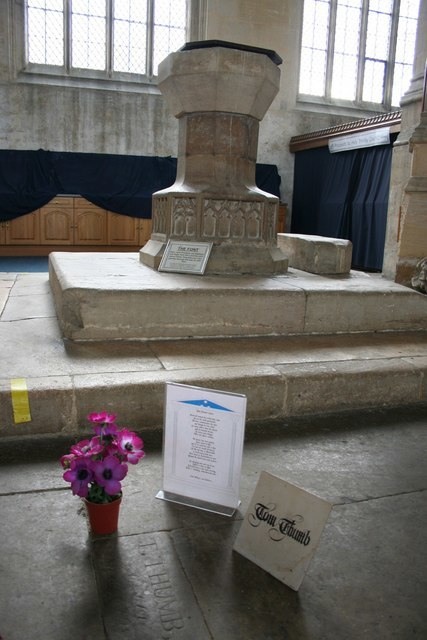 Elizabeth Ashworth's blog has another photo, with a closer look at the poem, as well as more history on the church. The poem, by Celia Wilson, doesn't have much information besides this is Tom Thumb's grave, he'd probably have a lot of stories to tell. Then there is Tom Thumb's house, not far away. Most articles on the grave mention it as if it is the actual home of the buried T. Thumb. However, further research shows that it's not a house that anyone ever lived in. It's a decoration. It is located on the ridge of Lodge House, in the Marketplace. The Lodge House is itself a building of historical interest. According to Historic England; "On the roof ridge is a ceramic [14th century] louvre in the form of a gabled house, known as 'Tom Thumb's House'." On medieval buildings, a louvre or louver was a kind of turret or domed structure on the roof, which allowed in air and light but not rain. The Tattershall and Tattershall Thorpe Village Site, available through Wayback, informs us that "The tiny house was thought to keep evil spirits out of the main building. Tom Thumbs house changed from one side of the Market Place when Mr Wright sold his shop." Here's the Lodge House on Google Maps. Can you see Tom Thumb's house? 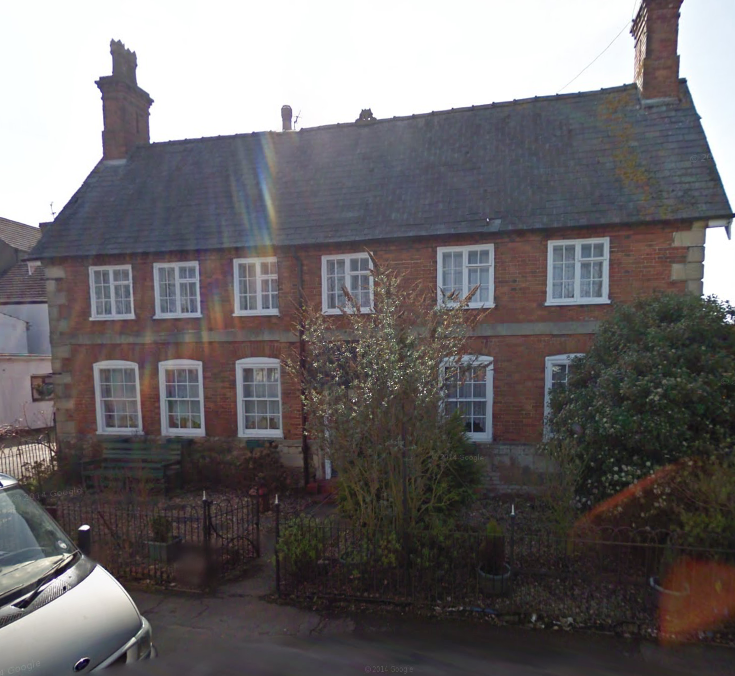 Try looking at this photo from the Village Site. 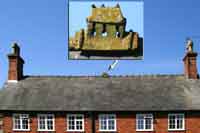 So: two traditions that Tom Thumb died somewhere around Lincoln. And one of them is dated around the same time as the first existing mentions of Tom Thumb.
If any of you readers go to Tattershall any time soon... you know what your homework is. 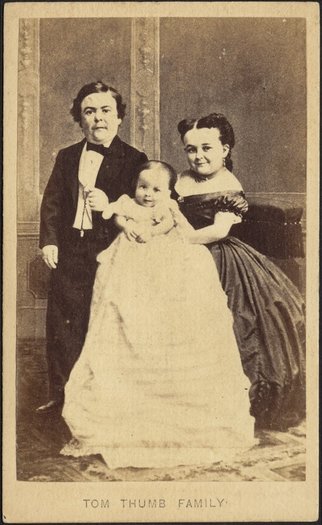 Charles Stratton, more famous by his stage name General Tom Thumb, wed Lavinia Warren on on February 10, 1863. Both had a form of dwarfism and were among P. T. Barnum's most renowned performers. They toured the world and people gathered to marvel at their small size - Charles was 3'4" and Lavinia 2'8". They rode in a miniature carriage. They had miniature furniture. All they needed was a miniature baby. It was announced that their child was born on December 5, 1863. Most sources referred to it simply as a baby or child, and at least one periodical appeared to think it was a boy. The overwhelming evidence, however, points towards a baby girl who was named Minnie after her aunt. She went on tour with them and was mentioned by name as early as 1864 in English papers. There was some disagreement as to whether Minnie would take after her parents' "Lilliputian" stature, but she was undoubtedly a hit and always described as a very beautiful child. They sold a fortune's worth of pictures of the happy little family. Tragically, less than three years later, newspapers reported that "Minnie Tom Thumb" (her nickname) had died. She suffered from an inflammation of the brain while in Norwich, where her parents were touring ("Foreign News and Gossip." Brooklyn Eagle. Oct 15, 1866). She was mentioned in Charles' obituary in the New York Times, and in 1882, the Strattons' manager, Sylvester Bleeker, said the child had looked just like her Aunt Minnie. Then, in 1901, eighteen years after Charles' death, Lavinia told newspapers that she had never given birth at all.
Renting babies from orphanages? Abruptly announcing the child's death when the charade had run its course? It was exactly the type of thing people expected from Mr. P. T. "There's a sucker born every minute" Barnum. In fact, skeptics tended to preemptively declare Barnum's acts hoaxes; as soon as 1878, obituaries for Lavinia's sister mentioned "the spurious Thumb baby." And the Strattons had played along with Barnum - or even suggested it to him in the first place. Tom Thumb's baby was all a hoax. OR WAS IT? In the BBC documentary "The Real Tom Thumb," historian John Gannon claims that they really did have a daughter. He produces a death certificate and burial record for "Minnie Warren Stratton, daughter of the celebrated General Tom Thumb," a contemporary news article, and finally a tombstone in Earlham Cemetery in Norwich. 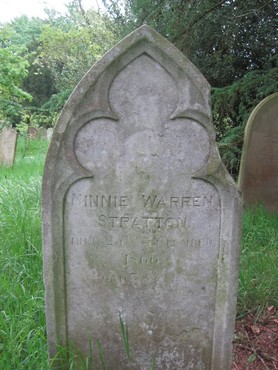 The Norfolk News said that the private funeral was invaded by a crowd of about a thousand, and that the General planned to later have the body moved to America and reinterred (Norfolk News 29 September 1866 p.5). The reinternment never happened, and the grave still lies there today. Newspapers stated that the Strattons cancelled performances in order to grieve.
However, it has been accepted for over a hundred years that the child was a hoax. and John Gannon's records are far from conclusive evidence. Although it seems technically possible that Lavinia bore a daughter, the timeline makes it unlikely. She was performing onstage constantly during the year when the child would have to have been born. Pregnancy would also have presented her with the same risks that took the life of her sister, who was even smaller than she was, and who died in 1878 after a painful and difficult childbirth. The baby died with her. It left a deep mark both on her family and on the public. Even years later, in 1892, an article on the wedding of Admiral and Mrs. Dot (another small pair of performers) said, “Every mother in the room thought of Minnie Warren, and felt a throb of fear at the risk this little woman in white was taking.” On the other hand, the same article indicates rumors “that Tom Thumb’s son is nearly six feet high, and that he is very proud of his little mother.” There was no reason for Lavinia to say she'd faked a baby - willingly participating in such a hoax would not have made her look good. And it seems odd that, in her autobiography, she would mention the death of her sister (which affected her deeply) but not her daughter. As a matter of fact, her autobiography, which was probably written somewhere around 1900 or 1901, has no mention of a baby whatsoever. Because it was even more painful than her sister's death? Or because it had become an old shame? Later on, Lavinia's family went out of their way to set the record straight. Her nephew, Benjamin J. Bump mentioned the baby hoax in his 1953 pamphlet, "The Story that Never Grows Old," and in his correspondence with researcher Alice Curtis Desmond. His wife Edna wrote a letter to the editor of the New York Times on April 21, 1946, saying that "The Tom Thumbs never had a child." It seems most likely that the Strattons never had children, but they may have grown attached to their surrogates. Based on the death record and grave, it seems that one of these borrowed children died in their care, and they grieved for her and had her buried under the name Minnie Warren Stratton. That seems to have marked an end to the touring with babies. On the other hand, Bogdan in Picturing Disability dates one of the family photos to 1868, and Desmond reported in her 1954 book that they were exhibited with a baby in 1881 (page 215). On the other other hand, A. H. Saxon suggests that some European newspapers mistook Lavinia’s sister for a child (Autobiography). It was too long ago and there was too much misinformation to be sure. What gives me more pause is the 1901 interview with Lavinia. Although this article is frequently quoted, something seems off with the math, and the mention of the child apparently reaching age four before any problem was seen. Even though this was decades later, and memory can fade, how does the life and death of "Minnie Warren Stratton" mesh with the baby boy described in that article? SOURCES
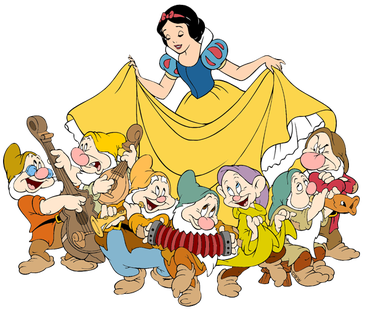 The dwarves of fairy tale and fantasy literature are characterized by their short stature and impressive beards. Tolkien defined the trope, and Disney undoubtedly helped by portraying six of Snow White's seven dwarves with full beards. In some stories, even female dwarfs are frequently supposed to have similar amounts of facial hair. Other little folk are similar, like garden gnomes with their white beards and leprechauns with red beards. Unlike the people of Europe who told stories of gnomes and leprechauns, Native American men rarely wore beards. However, in such countries there are stories of excessively hairy little people, like the Anishinaabe's Memegwesi, the Lakota's Wiwila Men (in some versions) or the Metis tale of the adventurous and womanizing "Little Man with Hair All Over" (a version of The Bear's Son, Type 650A). 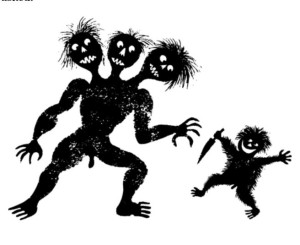 "Little Man with Hair All Over" fights a three-headed giant Tolkien based his dwarves on the dwarfs of Norse myth. However, Norse and Germanic dwarfs may not have originally been the short beings we immediately picture today. Still, the bearded dwarves we know today go back a long way. For instance, the ancient Egyptian god Bes had achrondroplasic proportions and was one of the few Egyptian deities depicted with a full set of facial hair. (James Romano theorizes that Bes is visually descended from a lion, which would explain his sometimes manelike 'do.) 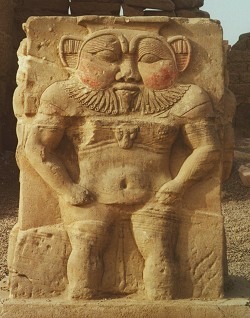 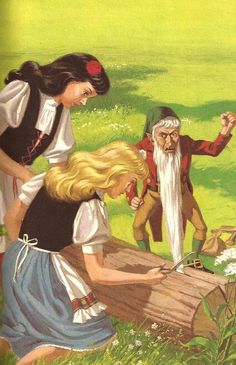 Through export, Bes would become a popular deity with other peoples such as the Phoenicians and the Cypriots.
In the 5th century BC, Ctesias described Indian pygmies two cubits tall, who raised livestock that was similarly small, and had a war going on with some cranes. These pygmies had grew their hair out to their knees and their beards past their feet, so long that they did not require any other clothing. There may have been seeds of truth in this story. Dwarfs in Arthurian romances were frequently described with beards, and in folklore throughout Europe, dwarves were described and drawn as little old men with long beards. Other examples:
So why do dwarves have beards? Facial hair makes it immediately clear that despite his small size, the dwarf is not a child but a miniature adult. Such illustrations leave no room for confusion. (Fairies, who are not typically shown with beards, are usually more childlike and/or feminine.) From there, the exaggeration takes over. Sometimes the beard's length becomes purely silly and imaginative, as in stories where the tiny man's beard is longer than he is and trails on the ground like a parody of Rapunzel's hair. Some readers - from Jane Yolen on Rumpelstiltskin, to numerous critics of Tolkien's gold-loving dwarves - have suggested that these bearded dwarves are anti-Semitic caricatures. Jews in the Middle Ages were frequently depicted wtih beards. However, the trope of the bearded dwarf is so widespread and so old that it seems unlikely that they were all based on Jews. I think it's more likely that they were based on real people with achondroplasia, or real pygmy tribes. I feel like I should also mention that there was a story published by the Grimms called "The Jew in the Thorns," which featured both a bearded, thieving Jewish man and a supernatural-type dwarf who helped the hero get revenge on him. The beard is a symbol of wisdom and age. According to SurLaLune, a beard can also symbolize magical powers or invulnerability, or a sign of a somehow animal nature. The hairy little people of many Native American lores could have been influenced by Europeans coming over, but hair can still be a mark of physical maturity, as well as, again, a sign that the being is more like an animal than a human. In Snow White and Rose Red, the dwarf's beard is the source of his power. He catches it in a crevice in a tree and in a fishing line, and the girls cut it off to free him, taking his powers away in the process. Along the same lines, in the Pomeranian "Das Wolfskind," an ugly little man with a long black beard is poisoning people's food. The hero, Johann, traps the dwarf's beard in a split block of wood, and later hangs him by the beard from the ceiling and treats him like a tetherball (Jahn). This is type 650A. Here we see the beard as a physical manifestation of power. When someone else gains control of it, he is quickly left emasculated and powerless. There is definitely room for some Freudian reading here. Ultimately, my instinct is that the simplest explanation is the best: dwarves were drawn with beards so that nobody would mistake them for children. Egyptian art of Bes, for instance, sometimes had childlike attributes (such as going naked or wearing a lock of hair on the right side of his head). He could have easily been mistaken for a child had he not been drawn with facial hair (Åkerblom 15). And it just went from there, until beards were a defining characteristic of fairytale dwarves. SOURCES
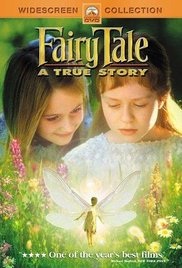 Fairy Tale: A True Story is available on Netflix now. It’s based on the story of the Cottingley Fairies, which I’m fascinated by, so I gave it a watch, skipping through some scenes because it was late. I enjoyed it more than I expected. It is indeed based on a true story. Starting in 1917, two cousins in Cottingley, England, named Frances Griffiths and Elsie Wright, produced photographs of themselves with what appeared to be real, live fairies. 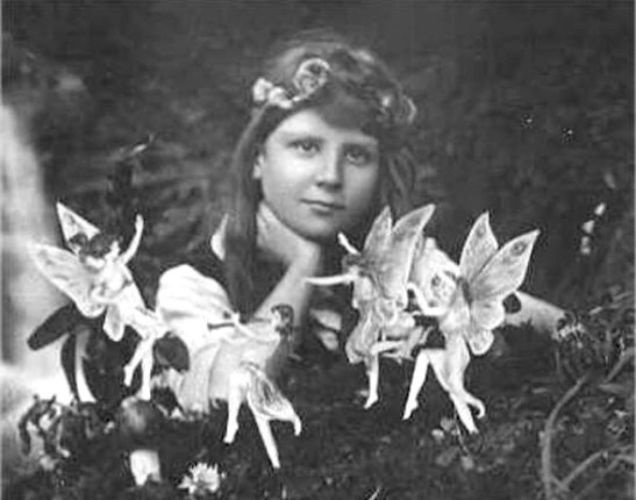 It’s strange to think that these photographs convinced so many. Even with the camera quality, their gnomes and sprites look flat and sharp-edged, like paper cutouts . . . which, of course, they were. Elsie’s father picked up on this, but somehow the “proof” of real fairies became huge news. This was mainly thanks to one of their most prominent champions, Sir Arthur Conan Doyle. Yes, the creator of Sherlock Holmes was totally on board with it. It wasn’t until the 1980s that Frances and Elsie admitted that it had all been faked. The delicate, dancing figures were copied from picture books onto cardboard and supported with hatpins. They still maintained, however, that they had really seen fairies. The film, which came out in 1997, wholly embraces the idea of the real live fairies. They are constantly flittering around. However, this makes the film somewhat disturbing on another note, because so much of it is about faith and belief in things unseen, in a higher power. It opens with a performance of Peter Pan, with the lead character crying, "Clap if you believe in fairies!" The audience of children applauds and cheers. One character is having a crisis of faith and searching for hope after her son's death; characters talk about belief again and again. And then it all turns out to be real. Yay!! But the “true story” it’s based on was a hoax. The filmmakers most definitely knew that it was a hoax. The end result is that the film feels like a mockery. That said, we never actually see the girls take a photo. And in one of the final scenes of the movie, juxtaposed with two other cases revealing hoaxes, a reporter discovers the paper fairies on their hatpins, in exactly the poses from the photo. However, the scene then turns around, and the supernatural takes back over. A ghost appears and frightens him away. The movie later ends with fairies filling the family's house and even the skeptical father finally being convinced. Perhaps the filmmakers were trying to portray the girls in the most positive light. Frances and Elsie always said, even after confessing to the hoax, that they really had seen fairies. Still, I don’t think it’s right to market this to children as "A True Story," with taglines like "Believe!" because it cheapens the truth. It's like saying "You can believe in this thing! Well, in this case, the proof turned out to be a bald-faced lie, but you should still believe in the thing because it's a happy thing that brings you joy!" And the fairies feel like a marketing ploy.
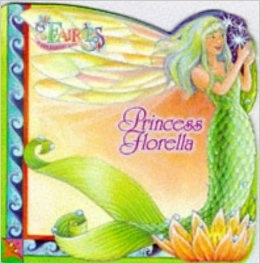
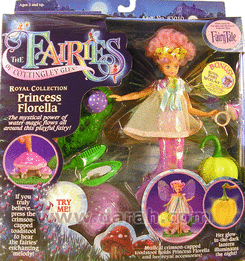
That's right - there were books and a doll line. "Fairies of Cottingley Glen." But at least it was well-researched. Sir Arthur Conan Doyle was a spiritualist who by all accounts wanted to believe. His father, Charles Altamont Doyle, was an alcoholic who suffered from epilepsy and depression, and spent the latter part of his life in a mental institution. While there, he filled sketchbooks with elaborate, fantastical artwork of elves and fairies. The movie touches briefly on this and it makes Doyle's motivations much more understandable. There was one scene that I actually stopped and rewound because the girls are walking through the woods calling the names of the fairies, and they’re all names from real folklore. A cast list reveals the names of even more fairies.
I've read about the Cottingley Fairies before, on the Internet and in The Fairy Ring: Or Elsie and Frances Fool the World, by Mary Losure. This book is written for children, but is a great read and incredibly well-researched. However, like the movie, it still clings to the idea that the girls really did see fairies, and they faked the photos because . . . um . . . they saw fairies.
Back to the movie. There’s beautiful scenery, the effects have aged surprisingly well, and I found myself enjoying it overall. Still, I was still bothered by that whole faith/fakery complex, and also the feeling that the fairies were real so that the moviemakers could sell toys. I would have much preferred to see the movie simply reveal that yes, the fairies were faked, and leave it at that, with maybe a faint hint at real supernatural events rather than full-blown "FAIRIES ARE REAL AND THEY'RE IN YOUR HOUSE." Even better, it'd be nice to see the girls actually taking the photos. (I must say, I never expected to see Dame Habetrot or the Shellycoat marketed as cute, big-eyed Barbies with fluorescent hair. The Shellycoat!) |
About
Researching folktales and fairies, with a focus on common tale types. Archives
April 2024
Categories
All
|
Writing in Margins
 RSS Feed
