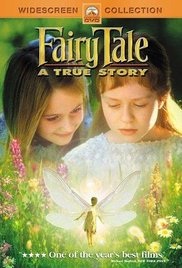
 Fairy Tale: A True Story is available on Netflix now. It’s based on the story of the Cottingley Fairies, which I’m fascinated by, so I gave it a watch, skipping through some scenes because it was late. I enjoyed it more than I expected. It is indeed based on a true story. Starting in 1917, two cousins in Cottingley, England, named Frances Griffiths and Elsie Wright, produced photographs of themselves with what appeared to be real, live fairies. 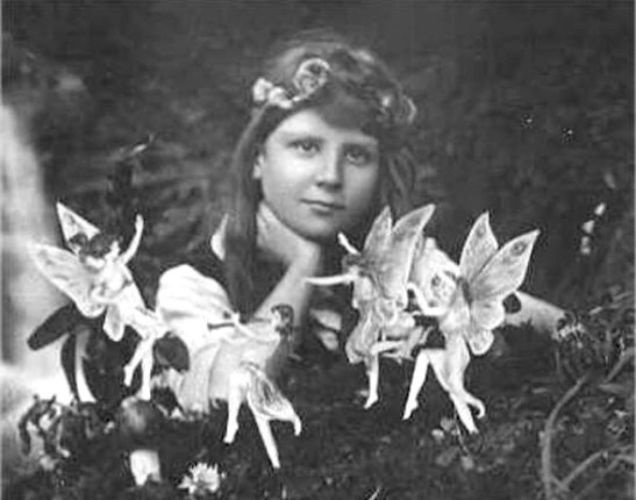 It’s strange to think that these photographs convinced so many. Even with the camera quality, their gnomes and sprites look flat and sharp-edged, like paper cutouts . . . which, of course, they were. Elsie’s father picked up on this, but somehow the “proof” of real fairies became huge news. This was mainly thanks to one of their most prominent champions, Sir Arthur Conan Doyle. Yes, the creator of Sherlock Holmes was totally on board with it. It wasn’t until the 1980s that Frances and Elsie admitted that it had all been faked. The delicate, dancing figures were copied from picture books onto cardboard and supported with hatpins. They still maintained, however, that they had really seen fairies. The film, which came out in 1997, wholly embraces the idea of the real live fairies. They are constantly flittering around. However, this makes the film somewhat disturbing on another note, because so much of it is about faith and belief in things unseen, in a higher power. It opens with a performance of Peter Pan, with the lead character crying, "Clap if you believe in fairies!" The audience of children applauds and cheers. One character is having a crisis of faith and searching for hope after her son's death; characters talk about belief again and again. And then it all turns out to be real. Yay!! But the “true story” it’s based on was a hoax. The filmmakers most definitely knew that it was a hoax. The end result is that the film feels like a mockery. That said, we never actually see the girls take a photo. And in one of the final scenes of the movie, juxtaposed with two other cases revealing hoaxes, a reporter discovers the paper fairies on their hatpins, in exactly the poses from the photo. However, the scene then turns around, and the supernatural takes back over. A ghost appears and frightens him away. The movie later ends with fairies filling the family's house and even the skeptical father finally being convinced. Perhaps the filmmakers were trying to portray the girls in the most positive light. Frances and Elsie always said, even after confessing to the hoax, that they really had seen fairies. Still, I don’t think it’s right to market this to children as "A True Story," with taglines like "Believe!" because it cheapens the truth. It's like saying "You can believe in this thing! Well, in this case, the proof turned out to be a bald-faced lie, but you should still believe in the thing because it's a happy thing that brings you joy!" And the fairies feel like a marketing ploy.
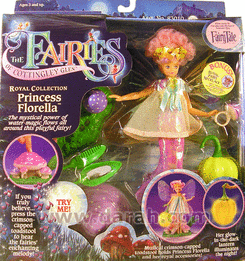
That's right - there were books and a doll line. "Fairies of Cottingley Glen." But at least it was well-researched. Sir Arthur Conan Doyle was a spiritualist who by all accounts wanted to believe. His father, Charles Altamont Doyle, was an alcoholic who suffered from epilepsy and depression, and spent the latter part of his life in a mental institution. While there, he filled sketchbooks with elaborate, fantastical artwork of elves and fairies. The movie touches briefly on this and it makes Doyle's motivations much more understandable. There was one scene that I actually stopped and rewound because the girls are walking through the woods calling the names of the fairies, and they’re all names from real folklore. A cast list reveals the names of even more fairies.
I've read about the Cottingley Fairies before, on the Internet and in The Fairy Ring: Or Elsie and Frances Fool the World, by Mary Losure. This book is written for children, but is a great read and incredibly well-researched. However, like the movie, it still clings to the idea that the girls really did see fairies, and they faked the photos because . . . um . . . they saw fairies.
Back to the movie. There’s beautiful scenery, the effects have aged surprisingly well, and I found myself enjoying it overall. Still, I was still bothered by that whole faith/fakery complex, and also the feeling that the fairies were real so that the moviemakers could sell toys. I would have much preferred to see the movie simply reveal that yes, the fairies were faked, and leave it at that, with maybe a faint hint at real supernatural events rather than full-blown "FAIRIES ARE REAL AND THEY'RE IN YOUR HOUSE." Even better, it'd be nice to see the girls actually taking the photos. (I must say, I never expected to see Dame Habetrot or the Shellycoat marketed as cute, big-eyed Barbies with fluorescent hair. The Shellycoat!)
1 Comment
I was researching a while back and came across an interesting analysis: the tale of Thumbling is the tale of the human spirit traveling through the world. This analysis bounces off a recurring idea that the soul is a tiny being. In The Annotated Hans Christian Andersen, Maria Tatar suggests that Tom Thumb and Thumbelina were inspired by the Hindu belief of the soul (atman or purusha) as a "thumb-sized being." It seems far-fetched to me that this belief would have migrated through Europe and surfaced in stories like this. I think they were born simply out of the popular interest in what is miniature and fantastical. She seems to be referring to the ideas set forth in the Upanishads; however, here the soul (atman or purusha) is not described as a thumbling, but as a tiny flame dwelling in the forehead or the heart. It is both infinitely small, the size of a thumb or the thickness of a hair, yet at the same time infinitely huge. The thumbling soul sometimes appears in Christian imagery (Philosophy and the Self: East and West). In Masolino da Panicle's fresco of the Crucifixion, a tiny man - the soul - emerges from the dying thief's mouth (pictured right).  In a 1520 French stained glass window in the Art Institute of Chicago, the soul of Judas Iscariot is also a tiny man, appearing from his stomach. And in the 1443 "Death of the Virgin" mosaic and other similar artwork, Christ cradles the infant-sized soul of Mary.
Spence suggests in British Fairy Origins that fairies are inspired by images of ghosts - thus fairies are tiny because they resemble the miniature "mannikin soul." Religion in Essence and Manifestation mentions again the Hindu ideas of the soul. It also describes the Toradja of Celebes [Sulawesi] as imagining a "mannikin" soul, the tonoana. The tonoana is actually one of three souls that each person possesses, and apparently leaves the body to become a werewolf. James Frazer says in The Golden Bough that in America, the Hurons, Nootkas, and the tribes of the Lower Fraser River all have similar ideas of the soul as a miniature, transparent double of the body. A Wailaki tale from California features a dream doctor who has to hunt down an escaped soul. The soul "resemble[s] a miniature person," and is found sitting by a little fire it's built. Frazer adds that this is a belief in Malaysia, too. This is a bit of a blanket statement over a group of diverse and complicated beliefs. In Malay tradition, some tribes held that there were actually more than one soul or kind of soul. I did find that Religion in Essence and Manifestation echoes Frazer, citing a chant from Malacca (a state in Malaysia) that refers to the soul as "little" and "filmy" and describes it as a bird. If you go to Wikipedia, it draws from James Hastings' Encyclopedia of Religion and Ethics Part 15, speaking of the soul or "semangat" (essence) being a miniature copy of the body, which flashes from place to place and is compared to a bird. This part of the soul can can leave the body during trances or sleep, and after death, passes into another creature or plant. In some Chinese stories, the soul is again a tiny double of the body, but this is a relatively rarer and newer idea compared to other Chinese descriptions of the soul. So the idea of the miniature soul pops up all over the world. The Religion of the Veda basically says all these ideas of the soul as a tiny man probably originated in the Upanishads with the thumb-sized flame. Chronologically speaking, those were recorded around 800-200 B.C., well before any of the other examples listed here. It still seems like a big step to say that the fairytale characters were descended from a Hindu description of the soul. However, I also remembered that there is a story called "S’homonet com un gri," or the little man as small as a cricket. In this Catalan tale, a couple meets an insect-sized boy, who calls them his parents and helps them around the farm. Thus far, it is a typical type 700 tale; however, he then reveals that he's the spirit of their deceased son, returned temporarily from heaven to aid them. So maybe Maria Tatar is onto something. However, even though the image of the miniature person could have stemmed from religious art or spiritual imagery, I still think thumbling tales are inspired simply by the appeal of the miniature. SOURCES
When I researched Tom Thumb weddings a while back, there was one thing that mystified me - and that was the name Jennie June. This was the name used in the Baker's play published in 1898, and in the majority of advertisements and reviews found as my research. It was clear how the Tom Thumb name had been inherited from General Tom Thumb and thence from the fairytale, but who was Jennie June? Wouldn't it have made more sense to call the bride Lavinia, after Mrs. Stratton? Another skit gave the bride the thematically appropriate name Lilly Putian. Maybe I'm overthinking it and it's just a random name that they threw in thinking it sounded good. Maybe, as I initially guessed, there's a connection to the tradition of June weddings. There have been plenty of women with this name. Anyway, I set out to create a timeline, seeking out possible inspirations for the name of Tom's bride. 1853: A book of poems by Benjamin Franklin Taylor, "January and June." I'm not sure of the original date of publication of these poems; they may have been previously published in the Evening Journal. Anyway, one poem is titled Jenny June/The Beautiful River. In a twilight like that, Jenny June for a bride, Oh ! what more of the world could one wish for beside, Jennie June (Jane Cunningham Croly): A very famous journalist who founded the Sorosis club for women in 1868. Wikipedia mentions that she may have first used the pen name of Jennie June as early as 1855. Whenever she first used it, she seems to have used a few at first before settling on that one and starting a trend of alliterative pen names. Her pen name soon became a household name, with her columns and clubs gaining popularity. In the 1880's, she edited a series of manuals for ladies, including an American Cookery Book and several books on needlework and sewing. I found many different accounts of what inspired her name.
However, Croly would have been twelve in 1841, and the earliest I can find proof of Taylor's poem is 1853. At seventy, when she is supposed to have been interviewed about this, Croly may have had trouble remembering the real specifics. However, the varying accounts, as well as the overly flowery style in the Oshkosh paper, make me think that there was some significant embellishment going on. Also, the first-person account in the New England Magazine never mentions Taylor. 1863: – “Jennie June” appears in Beadle's Dime Song Book, copied by permission of Firth, Son & Co. “Did you see dear Jennie June . . .” Also in 1863, General Tom Thumb got married, and the wedding was a huge media spectacle. In following years, other small performers, like Francis Joseph Flynn/General Mite in 1884, would also have widely publicized weddings. In 1892, of performer Admiral Dot and his wife Lottie Swartwood, it was said that "in their wedding garments they looked more like pretty little children than like a man and woman about to embark on the uncertain sea of matrimony." Perhaps it wasn't just the Strattons who inspired the wedding pageant. 1875-1876: The McLoughlin Brothers Paper Dolls includes a doll named Jennie June - a small girl with several different outfits, sold alongside characters like Polly Prim and Gerty Good for 8 cents; these were part of a series of smaller paper dolls, 5 5/8 " inches tall. I don't know exactly when this paper doll first appeared; the Uniform Trade List Circular has a mention of the name dated in 1866. Interestingly, there were also McLoughlin paper doll versions of General Tom Thumb, Lavinia Stratton, and their companions. 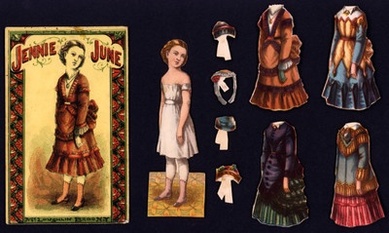 1891: The absolute earliest mention I've found of a Tom Thumb wedding in print - hosted by the First African Presbyterian Church. William Dorsey’s Philadelphia cites the Leon Gardiner Collection of the Historical Society of Pennsylvania.
1892: A song called “Little Jennie June” is printed in Album Melodies by Richard Ferber. 1896: “Sweet Jennie June,” a song by Henry J. Sayers 1898: Thirty-five years after the Stratton wedding, The Walter H. Baker & Co. of Boston put out a play 35 years later called, 'The Tom Thumb Wedding" - “as originally performed at the Union Tabernacle Church, Philadelphia, PA”. From this, we know that there was already a pageant tradition forming; it was just that now people were creating scripts. Here, the bride is named Jennie June, and this was the name I found most often browsing through old newspapers and photos. This was the name that kicked off a burning question that would only ever torment one single person in history. However, at the time, there were other scripts bopping around. Jennie June's chief rival seems to have been Lillian Putian Midget or simply Miss Midget. Again, this name seems less random than Jennie June. People would have gotten the reference to Gulliver's Travels; Tom Thumb was often compared to the people of Lilliput, and at their wedding, General Tom Thumb and his bride were headlined as "The Loving Lilliputians." (Speaking of General Tom Thumb, in Ohio in 1957, there was a "Mock Marriage of Tom Thumb and Miss Lavinia Warren." The earliest mention of Lillian I could find dates to 1901 in the Oklahoman, with a facetious wedding announcement. The writer was clearly having fun with references, as there's a mention of their address at "Gullivar Avenue." In 1911, a copyright was issued for "The Marriage of Miss Midget," or "The Marriage of the Midgets, or The Tom Thumb Wedding," written by May Burnworth. It was renewed in 1914. This was the Lillian Putian version - not the Bakers Plays version, though it usually bore the same name. Here, in a brochure filled with glowing reviews, at the end there is a stern "WARNING!!" All public performances must be under the direction of C. A. Rose, of the Baxter Printing Company, Kansas City, MO. (Incidentally, I found a mention in an 1914 Illinois Newspaper -
Still, that warning is pretty strong. In this reprint of their play, Bakers' puts up a bit of a defense.
In the meantime, there were some odd blends of the two brides' names. In an announcement in 1915, Mr. and Mrs. Lyttle Smalle Lilliput announced their daughter Jennie June's wedding. And in 1926, the bride was Miss Jennie June Midget. However, ultimately it seems to me that the Baker play and Jennie June have lasted longer. At least, in this day and age, I can easily track down the Baker play online, while I'm at a loss for finding any others. And references abound - for instance, there was a skit called "Tom Thumb's First Wedding Anniversary" by Donald V. Hock, published in 1934, with Jennie as the wife. Anyway, back to the mystery at hand. Namely - who is Jennie June? Maybe the writers thought of the little paper doll; maybe it was inspired by someone's copy of a Jennie June manual for ladies; perhaps they remembered Taylor's poem with the line "Jennie June for a bride." But I'm guessing it was just a random name that the writer found cute - most likely something born in the original Union Tabernacle Church skit cited by Baker's Plays. |
About
Researching folktales and fairies, with a focus on common tale types. Archives
April 2024
Categories
All
|
Writing in Margins
 RSS Feed
