 Rudaba: a Persian Rapunzel? The Brothers Grimm's Rapunzel is actually a rather unusual tale. It's an example of the tale type called "The Maiden in the Tower," but it's far removed from its roots among oral folktales, marked by the creative additions of a French author.
Worldwide, the image of a virginal young woman trapped in a tower has been persistent for millennia. Graham Anderson, in Fairytales in the Ancient World, attempts to tie Rapunzel to a fragmentary Egyptian story called "The Doomed Prince," in which a prince accesses his beloved's tower by jumping (pp. 121-122). Rapunzel has also been compared to the legends of Hero and Leander, or Saint Barbara. There's a clearer ancestress in the Persian epic Shahmaneh, written around 1000 AD. This work features a woman named Rudaba (River Water Girl), locked in a tower by her father. Despite this barrier, she falls in love with a man named Zal. In a very sweet scene, she offers Zal her long hair: "Come, take these black locks which I let down for you, and use them to climb up to me." But he says in horror that he doesn't want to hurt her, and instead obtains a real rope. They eventually convince their families to let them marry, and their son becomes a great hero. Are later versions an exaggeration of Rudaba's invitation to let someone climb her hair? Or was the writer playing on an oral tale where a man did climb a woman's hair, by pointing out that it would be painful? Either way, the scene suggests a seed of the story that would one day become Rapunzel. Petrosinella "Petrosinella" is usually cited as the oldest known tale identifiable as a Rapunzel type. This was an Italian literary tale published in 1634 by Giambattista Basile. It all begins when a pregnant woman named Pascadozzia sees "a beautiful bed of parsley" in an ogress's garden. Overcome with ravenous hunger, she waits until the ogress is away and then breaks in to steal some of it - multiple times. The ogress threatens her with death unless she hands over her child. The child, Petrosinella (Little Parsley) actually reaches seven years old before before the ogress nabs her and takes her to a distant tower. This tower is accessible only by climbing Parsley's long tresses of golden hair. A prince finds her, they fall in love . . . and then Petrosinella takes complete charge of the story. She steals three magical gall-nuts from the ogress and runs away with the prince. The ogress pursues them, but Petrosinella throws the nuts onto the ground, where they become a dog, a lion, and a wolf who delay the ogress and finally gobble her up. Petrosinella and her prince live happily ever after. I remember finding Rapunzel a rather pathetic figure when I read the story as a child. She just sat in her tower, unable to figure out how to escape when it was most important. Why didn't she find a rope, or cut her hair and use that? Where was this Rapunzel, flinging magical nuts and summoning monsters? More than fifty years after Basile, the next step appeared, and the story changed. Persinette The French aristocrat Charlotte-Rose de Caumont de la Force was among other women writing literary fairytales in the 17th centuries. They took inspiration from oral folktales, but put their own spins on them and used them to comment on their society at the time. La Force's story "Persinette" was published in 1697 in a book titled Les Contes des Contes. Persinette is derived from the French word "persil," meaning Parsley . . . so, "Little Parsley." It begins in a manner very similar to Petrosinella, but then sets out on its own path. For one thing, rather than a pregnant woman alone, de la Force gives us a couple expecting a child. It is the father, not the mother, who goes stealing parsley on his wife's behalf, and he's the one who's caught by the fairy owner of the garden. Instead of threatening him with death, the fairy offers him all the parsley he wishes if he will hand over his unborn child. The man agrees. The fairy acts as godmother, names the child and swaddles her in golden clothing, and sprinkles her with water that makes her the most beautiful creature alive. However, the fairy knows Persinette's fate and is determined to avoid it, so when the girl turns twelve the fairy hides her in a bejewelled silver tower filled with every luxury imaginable. When the fairy visits, she does so by climbing up Persinette's conveniently tower-length blonde hair. The story is exactly what you may remember: a prince hears Persinette singing and falls in love with her, eventually copies the fairy to climb up to the tower via hair, and their romance leads to pregnancy. The fairy is furious that her attempts to safeguard Persinette have been flaunted by Persinette herself. She cuts off Persinette's hair and sends her to a comfortable but isolated home deep in the wilderness. When the prince discovers his love gone and hears the fairy's taunts, he throws himself off the tower in despair. He doesn't die, but loses his sight. He wanders for years, until one day he happens on the house where Persinette lives with her young twin children. When Persinette's tears fall on his eyes, he regains his sight. However, the happy family realizes that the food around them (previously provided by the fairy) now turns into rocks or venomous toads when they try to eat, and they will surely starve. Despite this, Persinette and the prince affirm their love for one another. At this point the fairy takes pity on them, and carries them in a golden chariot to the prince's kingdom, where they receive a hero's welcome. It's a clear descendant of older tales. The beginning is that of Petrosinella. The maiden hidden in a tower to keep her from men, who becomes pregnant anyway and is cast out by her parent, also features in the Greek myth of Danae. But many of the most striking details - Rapunzel's forced haircut, the prince's blindness, the twin babies, and the healing tears - are all original creations by La Force. Our modern Rapunzel comes directly from her unique original fairytale. German translations of Persinette In 1790, a century later, Friedrich Schulz published a German translation of Persinette in his book Kleine Romane. It's not clear exactly how he encountered it, but it is very clearly a translation of La Force's story. His most significant contribution was to change the heroine's name. Rather than translating it to Petersilchen, the German equivalent of "Little Parsley," he replaced the coveted parsley with the salad green rapunzeln. The girl's name thus became Rapunzel. Then along came the Grimms. Although their goal was supposedly to collect the oral tales of Germany, their sources were typically middle-class families who'd read plenty of French fairytales. They ended up removing some of their stories upon realizing that they were clearly French literary tales (anyone heard of "Okerlo"?). But some stories stuck around which modern scholars now believe were not German in origin at all. The Grimms' first version of Rapunzel, in 1812, was very short and simple, almost terse. However, it reads like a summary of Schulz, including his unique use of the name "Rapunzel," indicating that their source was someone who had read Schulz's "Rapunzel" and was retelling it. The Grimms were aware of Schulz, mentioning him in their notes, but believed he was writing "undoubtedly from oral tradition." They do not seem to have been aware of the French tale at all. The most important change that the Grimms made was removing all sympathy from the fairy godmother's character. No longer was Rapunzel's tower a silver palace filled with delights; it was just a tower. They left out the ending with the reconciliation between Rapunzel and her godmother. Starting in 1819, as the Grimms edited the story with more descriptions and deleted ideas that were too French, they changed the fairy to a sorceress known as Frau Gothel. (Gothel is a German dialect word for "godmother.") Over later editions, she became an old witch. They edited her into something more similar to the ogress of the older Italian tale. They also toned down the story for children, removing references to unwed pregnancy. Rather than Rapunzel's pregnancy betraying her affair, she becomes dangerously stupid, blurting out that her godmother is much heavier than the prince. By the end she is mysteriously accompanied by her twin children, but nobody brings up pregnancy or scandalous unchaperoned visits. You can read D. L. Ashliman's comparison of the Grimms' first and final versions of Rapunzel here. Conclusion Rapunzel is a German author's translation of a French literary tale. Analyses should take into account how different Rapunzel is from its oral ancestors. I found it interesting that while the heroine's name can vary, the most common version by far is "Parsley." Perhaps elements of the La Force story did enter oral folklore. In their notes, the Grimms briefly mentioned a Rapunzel-like tale which began similarly to Bluebeard. A girl lived with a witch who gave her the keys but forbade her to enter one room. The girl peeked in anyway and saw the witch with two huge horns on her head. The angry witch locked the girl in a tower, accessible only by the girl's long hair, and the rest of the tale proceeded like Rapunzel. This version was summarized in their notes for The Lord Godfather (link in German). In some notes, this story seems to have become confused and attached to Friedrich Schulz’s Rapunzel, but I haven’t found any evidence that it appears in Schulz; his version of Rapunzel is identical to La Force’s Persinette. Personally, I was inspired to look into Persinette when I stumbled upon a claim on Tumblr that La Force's 17th-century story featured a heroine with psionic hair that she could use as extra arms or wings, and who was raised by a fairy named Gothelle. Frankly, this sounded ridiculously anachronistic. For one thing, "Gothelle" is just a faux-French spelling of the German word Gothel. Yet I found people reblogging it as if it was a fact. In truth, this description is from a modern retelling of Persinette in the webcomic "Emerald Blues." The fact that people latched onto it shows an element of wishful thinking. Modern readers want a more active heroine who could be a match for any fairy or witch. But in fact, there actually is an older Rapunzel who is an active heroine and a sorceress in her own right: Petrosinella. There's also the real Persinette, with its positive portrayal of female relationships, and a strict fairy godmother who is ultimately loving and benevolent. And there's the Persian heroine Rudaba, whose story sensibly points out over a thousand years ago that using someone's hair as a ladder might be painful. There are fairytales containing sexism and passive heroines, but just as often there are tales of brave, clever and magical women. Next time: some alternate endings to the Rapunzel story. Did you know that some versions keep going and become a gender-flipped version of Beauty and the Beast? SOURCES
Blog posts
1 Comment
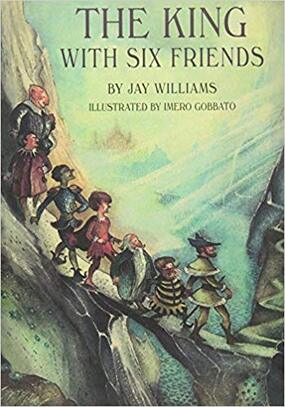 This was one of my favorite fairytale books as a child. I still have my copy, although it's fraying and the spine is taped together. The illustrations have a dreamy, misty feel.
It follows a king who has lost his throne and crown, who goes out to wander the world. He encounters other travelers, who each have strange gifts. One can turn into an elephant, another into fire, and so on. They reach a kingdom where the king is offering his daughter's hand in marriage, but there are tests to complete. With the help of his extraordinary friends (the fire-man, for instance, devours an impossibly large feast), the lost king passes the tests and gains the princess's hand. This is ATU Type 513A, a widespread tale. The Grimms published one called "The Six Servants." It's fun particularly for the image of what would, in modern terms, be a team of superheroes. One fascinating early example is the Welsh tale of Culhwch and Olwen, possibly dated to around the 11th or 12th century. This is also one of the first existing stories connected with King Arthur. Culhwch's stepmother curses him so that the only woman he can marry is Olwen, beautiful daughter of a giant named Ysbaddaden. (This scene, with Olwen described as snowy and rosy-red, falls in with many stories where a prince seeks a bride as white as snow. Her ogre-like father needs his heavy eyebrows lifted up so he can see - another trope from those stories.) However, as it continues, Culhwch goes to his relative King Arthur for help. Because, of course, Ysbaddaden requires that several impossible tasks be completed before his daughter can marry anyone. This version abounds with mystical powers, so that Arthur's warriors resemble superheroes more than anything else. Cei (known better today as Sir Kay) can generate heat. A Welsh god, Gwyn ap Nudd, is among their number. The court list is prodigious. I do find it interesting that Arthur initially sends six of his warriors to scout things out when he hears of Culhwch's quest. Cei (who as mentioned is super hot), Bedwyr (who sheds blood faster than any other fighter), Kynddelig (an extraordinary guide), Gwrhyr (who knows all tongues), Gwalchmai (or Gawain, who always achieves his goals), and Menw (who can cast illusions and shapeshift into a bird). This is also the Greek myth of Jason and Medea. Jason captains the Argo, a ship crewed by gifted heroes and demigods. Medea is the villain's daughter who works magic and helps her lover flee. The King with Six Friends has an addition that is my favorite conclusion to this kind of tale. One might wonder why his friends don't get the kingdom and the princess, since they did all the work. And this is brought up in the text! But one of the friends responds, "He did what only a good king can do . . . He led us." 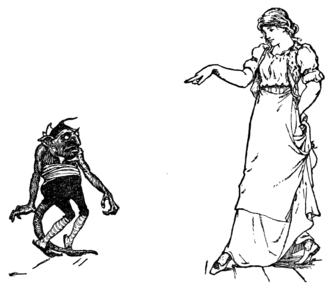 "The Name of the Helper" is the title assigned to the Aarne-Thompson type 500 family of fairytales. The main character is usually a young woman, confronted with an impossible task of spinning. She must produce a ridiculous amount of thread, or even spin it into gold. There’s no way for her to do it, until she receives otherworldly help from a strange being. However, she must now guess this creature’s name (hence the title of the tale type). Rumpelstiltskin is the most famous example, but there are many others, usually nonsense names, perhaps with a rhyme or repetitive rhythm. In Celtic countries, the helper’s name nearly always includes the syllable “tot” or “trot.” I have a theory on where this syllable came from, but first, the list:
England
Habetrot is interesting in that she has a whole group of associates, one of whom has the name Scantlie Mab (harkening to Queen Mab). There's a possibly connection from Habetrot to Holle, Perchta and other European goddesses associated with spinning. This goddess, who appears in many variants with hundreds of names, can be benevolent or fearsome. She usually travels at night with a group of attendants, entering houses where offerings of food should be waiting. She might be a tutelary guardian who helps women spin, or a bogeywoman who punishes them for spinning on the wrong day. The very word "fairy" might be tied to "fata" or "fate," beings in mythology who spun the thread of life. In French, a related character bore the name Dame Abonde or Lady Habundia, meaning "abundance." She and her attendants, the good ladies, entered houses at night. Follow this, and a character like Habetrot must be a deity associated with textiles, who leads a group of otherworldly ladies, and watches over young women. However, the majority of the Tot/Trot family is male. They cannot be tutelary goddesses. They also tend to be malevolent. Habetrot's name may be a later addition to the Habetrot story, which is less related to Rumpelstiltskin and instead belongs to the family of "The Three Aunts" (Norway) and "The Three Spinning Women" (Germany). In these stories, rather than any baby-stealing plot, several strange-looking but kind old women (three of them, just like the Fates in Greek myth) help the heroine attain a happy marriage and a leisurely life. They ask nothing in return for their help, and remain unnamed, as there is no need to find out their names. There is a scene where the girl overhears Habetrot's name, but it's really not important to the story. Incidentally, "Habetrot" resembles "Habundia" with the "trot" sound added on, and both are benevolent fairy ladies who lead a train of followers. Plenty of people have already looked at the "tot/trot" family. W. B. Yeats' "Even Trot" (who, like Habetrot, is benevolent) gives a very literal and moralizing translation: "Go steadily along, but let your step be even; stop little; keep always advancing; and you'll never have cause to rue the day that you first saw Even Trot." Sir John Rhys, inspecting Welsh variants, connected Sili go Dwyt to seily or seely - happy or blessed - connected with the Seelie Court or seely wights, old fairy names. Although "go Dwyt" could literally mean tidy, Rhys suggests that the dwt came from twt or tot. Although Trwtyn-Tratyn is a masculine name, Rhys finds the word trwtan or trwdlan to mean a deformed serving maid. From Gwarwyn-a-throt, he translated gwarwyn as "white-necked" and throt as connected to trot. Trot and twt, says Rhys, are not native Welsh words - but I don't think he offers any real theory on what they do mean. R. Morton Nance did have at theory. Based on Mollyndroat possibly meaning a druid's servant, Nance suggested that the Icelandic Gillitrut means "druid's gillie" (a ghillie being a servant). So a droat, trot or trut is a druid. I would take a different approach. Going back to England, the Denham Tracts list of monsters and bogeys includes two intriguing names: gally-trots and tutgots. A gally-trot is a frightening apparition in Suffolk folklore. Edward Moor wrote that it was an apparition known in Woodbridge, which sometimes appeared as a white dog as big as a bullock, and chased people. It especially haunted a place called Bathslough. Moor declares that he "can make nothing of the name; nor much of the story." (Suffolk Words and Phrases, 1823). "Gally" means to scare or worry (hence the word gally-beggar, or scarecrow). The “trot” part is less clear – perhaps because it runs at people. One English bogey-spirit of the “black dog” family is called Padfoot for the sound of its walk, so maybe this is a common idea. Could there be a connection from the gally-trot to Gilitrutt? As for tutgots: Tut-gut, along with tut and tom-tit, were Lincolnshire words for a hobgoblin. Tutgot may be interpreted as tut-gotten, or taken away by the fairies and goblins. (Brogden, Provincial Words and Expressions current in Lincolnshire.) (So if a tom-tit is a goblin, is Tom Tit Tot literally named "Goblin" by this reckoning? That seems a bit on-the-nose for a story about an impossible guessing game.) The English Dialect Dictionary quotes a story where a man was spooked on the road by a glimpse of something white, and remarked, "I thowt I'd happened of a tut" - or, "I thought I'd run into a tut." Pishey Thompson, in The History and Antiquities of Boston, mentions a "hobgoblin, or sprite" known as the "Spittal Hill tut" who took the form of a horse, and would harass and chase away anyone who passed by Spittal Hill. It might have been the site of a murder, or maybe the creature was guarding treasure. So then, a tut or trot is a bogey-beast, a white apparition which takes animal form and chases people. In the case of both the gally-trot and the Spittal Hill tut, there is a particular place which it likes to haunt. The Spittal Hill tut in particular lives at a hill where either a body or treasure could be buried, like a burial mound. You might say that the Rumpelstiltskin fairy also has a particular haunt; the hero must find out the name by following the fairy back to his or her home, usually out in a forsaken wild place and often subterranean. Habetrot lives in a cavern and Titty Tod beneath a fairy mound. Was the tut or the trot a hobgoblin which inspired these characters? Is this a fairy name with a forgotten root? Where does the shared ancestor lie in all these names? Two suggestions appear to me. One is that it is derived from "tot," a word for a little child, which may come from Scottish. Maybe it is related to the Icelandic word tottr, or dwarf. Compare also the Danish name Tommeltot, used for the Danish thumbling. (In England, Tom Thumb and the possibly related Tom Tumbler appear as monsters in Reginald Scot's Discovery of Witchcraft (1584), and Tom Thumb in his earliest appearances is associated with fairyish and demonic traits.) Tom Tit Tot is close to the bird name tomtit, which itself is a shortened version of "tom titmouse." One sense of the word "tit," like "tot," is used for anything small, and is a common name for small birds. So then, perhaps, Tom Tit Tot means Tom Little Little. The character in question is "a small little black thing with a long tail." That would fit, as would the frequent description of Rumpelstiltskin characters as little men and little women. But in some cases, like Mollyndroat's, the Rumpelstiltskin figure is a giant. That doesn't fit. Maybe trot is the way to go instead. "Totter" also means an uneven walk, bringing "tot" back in. Could this be a reference to the fairy having a strange walk? There are many different types of otherworldly creatures in folklore and myth, but there is a consistent thing about their feet. They have deformed legs, backwards feet, or inverted knees. The Brazilian Curupira and Ghanaian mmoatia are described with feet affixed backward. The henkies of Shetland and the Orkney Islands were trolls who would "henk," or limp, when they danced. Fauns of Greek mythology were goat-legged and hoofed. They lent this trait to Puck and to popular depictions of the Devil. Also from Greek myth, sirens were depicted as everything from human-headed birds to women with bird feet. This is another surviving trait. Jacob Grimm mentioned a group of dwarfs who wore long cloaks covering their feet; when someone sprinkled ashes on the ground to catch their footprints, it was discovered that the dwarves had the feet of ducks and geese. Jacob Grimm, seeking evidence of a Germanic goddess named Berhta or Perchta, found many variants on the name "Bertha with the foot" - "Berte as grans pies," "Baerte met ten breden voeten," as well as the idea of a goddess-like figure with a bird's foot. The goddess Perchta is often described with one mismatched foot - either too large, or the foot of a goose. Grimm decided that "It is apparently a swan maiden's foot, which as a mark of her higher nature she cannot lay aside (any more than... the devil his horse hoof) and at the same time the spinning-woman's splayfoot that worked the treadle." A god or goddess associated with spinning might very well have odd feet and an unusual gait. Rumpelstiltskin types are often described to walk around or pedal at a wheel when spinning. Dancing is also a frequent activity for them. Rumpelstiltskin is caught saying his name while "jumping about as if on one leg." Terrytop and his friends dance with a clattering noise "as if they had on each foot a pewter platter." The kindlier Habetrot is found "walking backwards and forwards" spinning with her distaff. She and all of her attendants are deformed from the work of spinning nonstop all their lives. In "The Three Spinning Women," “[t]he first [woman] had a broad flat foot, the second one had such a large lower lip that it hung down over her chin, and the third one had a broad thumb.” They attribute these traits to peddling, licking and twisting thread. So the name might be based on "tot," for a little creature, a dwarf ("tottr"). Or it could be "trot" or "totter," meaning that the creature is an otherworldly being with strange feet or one splayfoot. Or something entirely different! Somehow I doubt that it is derived from "druid," but I could be wrong. There's also a German nightmare spirit named a "drude" or "trute." The word "trot" has been used to mean old woman. I, for one, enjoy the idea that the tot or tut was a now-forgotten English hobgoblin, and that was how people came up with the names of Tom Tit Tot, Habetrot, the gally-trot, and others. Being "tutgot," or taken by tuts, was a worrying prospect, and indeed, Terrytop and Tom Tit Tot are eager to carry off young maidens for dark purposes. Tut or trot would be a root word, much like Puck with Puck-hairy and nisse-puk, and Hob with Hobgoblin, hobby-lantern and hobbit. Incidentally, the roots of both Puck and Hob are mysterious, too ancient to truly determine. However, I try to be wary of tying words together based on a surface resemblance, so I'll leave it at the basics. There is a widespread folktale type where a fairy's name must be uncovered. In Celtic countries that name usually includes the stem "tot," "trot," "top," "tod," or something similar, to the point where this concept has merged into other stories - like Habetrot, who is quite different from Rumpelstiltskin, and Gwarwyn a Throt, whose story is otherwise just random antics of a brownie-like house fairy. Despite the fact that this fairy is associated with spinning - traditionally a feminine activity - he is generally male. He is also generally evil, wanting to steal away human women and children. If female, the character is slightly more likely to be benevolent—perhaps bleeding into the archetype of Perchta and Holle—but that's not a hard and fast rule. Resources
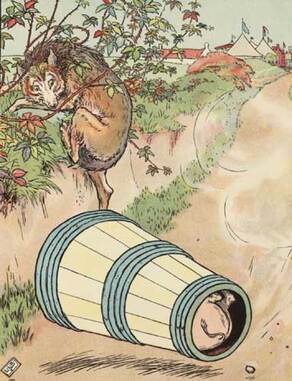 The Three Little Pigs is one of the most iconic fairytales, instantly recognizable in any list. But where did it come from? In fact, the earliest known version of the story actually features not pigs, but pixies.
This story, Aarne-Thompson-Uther Type 124, resembles tales like "The Wolf and the Seven Young Kids" (ATU 123) and "Little Red Riding Hood" (ATU 333) where a predator tries to gain access to its prey's home through trickery or force. The listener identifies with a child like Red Riding Hood, or a domesticated animal like the goats or pigs. Sometimes the victim escapes with a clever trick. In other versions, he or she is gobbled up whole, and may or may not escape the wolf's belly. However, the three pigs are sort of latecomers. In 1853, an untitled story about a fox stalking a group of pixies was published in English forests and forest trees, historical, legendary, and descriptive. The story was also recorded in “The Folk-Lore of Devonshire” in Fraser's Magazine vol. 8 (1873). The pixies in the fox story live in an oddly domestic colony; two who dwell in wooden and stone houses are eaten. The fox, in search of prey, knocks at each door and calls "Let me in, let me in" before breaking the house open. However, a clever third pixie lives in an iron house which the fox can't break into. At the end, the fox finally captures the pixy in a box. However, the pixy uses a magical charm to trick him into switching places, and the fox dies. This is the earliest known version of the story. So how did we get to pigs? [Edit 3/23/21: J. F. Campbell's Popular Tales of the West Highlands, first published around 1860, mentions the pig story. "There is a long and tragic story which has been current amongst at least three generations of my own family regarding a lot of little pigs who had a wise mother, who told them where they were to build their houses, and how, so as to avoid the fox. Some of the little pigs would not follow their mother's counsel, and built houses of leaves, and the fox got in and said, "I will gallop, and I'll trample, and I'll knock down your house," and he ate the foolish, little, proud pigs; but the youngest was a wise little pig, and, after many adventures, she put an end to the wicked fox when she was almost vanquished, bidding him look into the caldron to see if the dinner was ready, and then tilting him in headforemost."] In 1877, Lippincott's Monthly Magazine featured William Owens' article "Folk-Lore of the Southern Negroes," including the story of "Tiny Pig." Seven pigs are hunted by a fox, who goes to each of their houses and asks entrance. The pigs each reply in rhyme, "No, no, Mr. Fox, by the beard on my chin! You may say what you will, but I'll not let you in." The fox proceeds to blow down each house and eat the occupant. Only the seventh one, Tiny Pig, has built a strong stone house, and the fox finds that he cannot blow it or tear it down. The fox attempts to enter through the chimney, but Tiny Pig has a fire waiting for him. In an odd note, Owens compares "Tiny Pig" to an Anglo-Saxon tale called "The Three Blue Pigs." He implies that this was the source for the African-American tale. He gives no source for this story, but it seems he expected his readers to recognize it. However, Thomas Frederick Crane, a collector of Italian tales, seemed baffled by the reference and wrote that he was unable to find the tale. The tale seems to have been strongly present in African-American folklore of the time. In addition to this appearance in Lippincott's Magazine, Nights with Uncle Remus: Myths and Legends of the Old Plantation by Joel Chandler Harris (1883) featured "The Story of the Pigs." Five build houses for themselves from "bresh," sticks, mud, planks, and rock. Brer Wolf sweet-talks and lures each one, coaxing them to open the doors of their respective homes. In this way, he devours them one by one. Only the Runt sees through his deception. In a scene reminiscent of both Red Riding Hood's dialogue with a disguised wolf, and the Seven Kids' protests that the wolf doesn't resemble their mother, Runt sees through each of Brer Wolf's claims that he's one of her siblings. Again, there is the ending with the chimney and the pig's waiting fire. A Harris story published later, "The Awful Fate of Mr. Wolf," told a similar narrative with Brer Rabbit as the protagonist. "The Three Goslings" appeared in Thomas Frederick Crane's Italian Popular Tales in 1885. This is another close variation on the story, but with geese rather than pigs. Here we find the wolf blowing down houses. Ultimately, the third gosling pours boiling water into the wolf's mouth to kill him, and then cuts open his stomach to free her sisters. (I'm not sure why the boiling water didn't hurt them.) Crane collected this from Tradizioni popolari veneziane raccolte by Dom. Giuseppe Bernoni, vol. 3 (c. 1875-77). He also included a story called "The Cock," which similarly featured a wolf blowing down animals' houses (in this case built of feathers). Our modern famous trio of pigs can be traced back to James Orchard Halliwell's Nursery Rhymes of England (1886). The tale was titled "The Story of the Three Little Pigs." Here is the final pig living in a brick house. Here are the rhyming couplets with the wolf calling out, "Little pig, little pig, let me come in" and huffing and puffing houses in. A few scenes, such as the wolf trying to lure out the pig and the pig duping him, are identical to scenes in the pixie story. As in the Italian stories, the wolf blows down the houses, and as in the African-American versions, the ending has the wolf's descent through the chimney. (However, the pig boils him and eats him, reminding one of the Italian gosling's boiling pot of water.) The British version featuring the pigs gained popularity through Joseph Jacobs' English Fairy Tales (1890), which cited Halliwell. Another version showed up in Andrew Lang's Green Fairy Book (1906). Some African and Middle-Eastern versions tell the same story with different animals, such as sheep or goats. In some areas, human main characters seem more popular, as in the Moroccan tale of Nciç (Scellés-Millie, Paraboles et contes d’Afrique du Nord, 1982). A sultan and his seven sons travel to Mecca, but one by one the sons lose courage and build houses - one with walls of honey, another with walls of date paste. The seventh and smallest son Nciç builds an iron house and faces off against a ghoul. The story of the fox and the pixies remains an outlier. It is the first known tale to introduce the now-familiar framework of the Three Little Pigs. However, it is also oddly rare. Pigs, fowl, goats, and humans all star in similar tales, but I've never encountered another version with pixies. And what exactly makes foxes a natural enemy of pixies? The 1873 article in Fraser's Magazine remarks that "There is a very curious connection between the pixies and the wild animals of the moor, especially with the fox, which features in many local stories. These turn frequently on a struggle in craft and cunning between the fox and the pixie." However, the only story cited is this one - not exactly a large sample size - and the author admits that the story of the pixies living in individual houses of iron, etc., is atypical. Meanwhile, in the other stories recorded in English Forests, pixies are "merry wicked sprites" who torment horses, lead humans astray in the woods, and steal babies. These are not cute winged fairies. They appear as "large bundles of rags," or occasionally tiny sprites dressed in filthy rags. Rather than being harmed by iron like some folkloric fae, they are miners and metalworkers. In one story, they are apparently immune to gunfire ("they were not to be harmed by weapon of 'middle earth'"). In the fox story, however, they are hapless creatures easily devoured by a woodland animal. The only pixy-ish thing they do is at the very end, when the final survivor uses an unspecified "charm" to entrap the fox. I believe the answer is lies in a confusion between similar words. The word "pixy" is close to "pig" - and that's before you get into related words like puck or pug. One variation is pigsies or pigseys. Pigsie is a Devonshire term for pixie. The story of the fox and the pixies is from Dartmoor, in Devon. The pixie version could have arisen through a misinterpretation of the animal pig (or piggie) as the supernatural creature pigsie. If it was originally about pigs, that would explain why similar tales frequently feature animal heroes, and the same tale was widespread with pig protagonists even on the other side of an ocean. It would also explain why the Dartmoor tale's pixies act so unpixylike and helpless, with only one mention of magic thrown in at the end almost as an afterthought. I can only think of a couple of versions of The Three Little Pigs which feature fairies as protagonists, and they are modern take-offs. In 1996, a book titled Feminist Fairy Tales by Barbara Walker featured a parody of the Three Little Pigs as "The Three Little Pinks." In this fable about girl power, a misogynistic gardener named Wolf comes at odds with three flower fairies who share the task of painting flowers pink. I found this parody less than impressive. But it's still intriguing in how it cycles - perhaps unknowingly - back to one of the earliest published versions of the tale. Oh, and there was an early 20th century version of "The Wolf and the Seven Young Kids" which featured a goblin and seven little breeze spirits. That was "The Gradual Fairy" by Alice Brown, published in 1911. I do wonder about the "Three Blue Pigs" tale mentioned by William Owens, which could potentially date back before the tale of the fox and the pixies. Perhaps it didn't survive. That would be a fascinating find, though. SOURCES
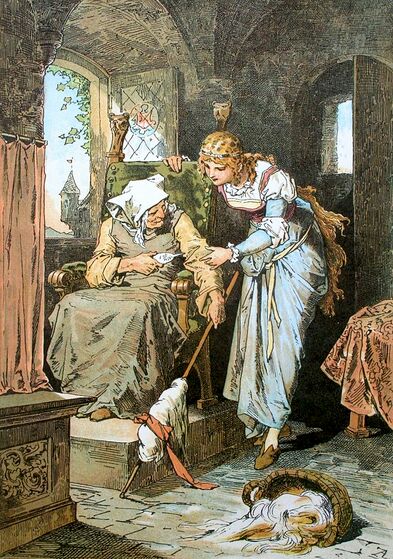 The good and wicked fairies in Sleeping Beauty have an interesting heritage. In medieval legend, fairies and fays often attended the birth of heroes to prophesy their fates. These stories go back even further, to mythology and ancient religions, where goddesses looked upon newborn children and laid out their fates.
Perceforest is a French prose romance first printed in 1528, but may have been composed as early as 1330. It's very very long, but there's one section in particular that is clearly a version of Sleeping Beauty. This interlude tells of Troylus and Zellandine, ancestors of Sir Lancelot (yes, that one). When Zellandine was born, her aunt was given the task of setting a table with food for the goddesses who witnessed the childbirth, so that they would be pleased and lay out a blessed life for the child. These three goddesses were Venus, Lucina, and Themis. In myth, Venus is the goddess of love, Lucina of childbirth, and Themis of order. Themis is also the mother of the three Fates, and in this tale she is identified as the goddess of destiny. When the goddesses sat down to eat, Themis' knife was missing. It had just fallen under the table, but Themis felt insulted; thus, she cursed Zellandine to prick her finger with flax while spinning and fall into an unending sleep. The goddess Venus, more kindly disposed to the child, found a way around the curse. When Zellandine falls into a sleep from which she cannot be wakened, the goddess Venus arranges for her paramour, Troylus, to be carried into her tower. Influenced by Venus, Troylus has sex with Zellandine and she becomes pregnant and gives birth while still unconscious. Her newborn son Benuic, trying to suckle, sucks on her finger and draws out the splinter of flax, awakening her. In "Sun, Moon and Talia" - included in the Italian Pentamerone (1634) - the story is much the same, except that there are no goddesses in attendance. Instead, wise men and astrologers cast the newborn Talia's horoscope and foretell that a splinter of flax will endanger her. The story proceeds in much the same way, with a few exceptions. Instead of one baby, the sleeping Talia gives birth to twins named Sun and Moon. And the story does not end with her awakening. The king who found her already has a wife! In her jealousy, she attempts to have Talia and the kids cooked and eaten. Sympathetic servants save them, the queen is put to death, and Talia lives a long and happy life with her family. Unlike Zellandine, Talia displays no trauma after what is, honestly, a rape. Zellandine loves her betrothed but still feels violated, and the narrative at least hints that Troylus' actions are wrong. Talia and the king, though, are hunky-dory. In 1697, Charles Perrault retold this tale as "The Sleeping Beauty in the Wood." The three goddesses of Perceforest are echoed by seven fairies who show up to give gifts at the christening, and an eighth, elderly fairy who shows up unexpectedly. Everyone thought she was dead, so unfortunately they did not provide her a place setting with jewel-encrusted golden utensils like the other seven fairies. When the other fairies give gifts of beauty and good temper, she adds an early death. Like Venus, another fairy softens the curse to a sleep (this time around, it is specifically for one hundred years) and lays the path to an eventual happy ending and romance. The unsavory elements of "Talia" are softened. Perrault's prince doesn't even kiss Beauty. He just happens upon her at the very moment when she naturally awakens. Their children Dawn and Day are born legitimately after a proper wedding and consensual sex. Even the jealous first wife from "Talia" is replaced by a monstrous mother-in-law. These three stories are all different, but all point to legends about Fate and Destiny. In fact, the word "fairy" may ultimately derive from the Latin Fata, or fate. You have the the Greek Fates or Mourai, the Norse Norns, and others worldwide. In the Greek myth of Meleager, the Fates appear a week after his birth to foretell his fate that he will die as soon as a certain piece of wood on the fire is consumed. His mother seizes the wood and puts it in a safe place, but of course eventually the wood is burnt and Meleager perishes with it. These Fates were portrayed as three old women spinning thread; each thread was a human life. Klotho spun the thread, Lakhesis measured it out, and Atropos cut it. There is another medieval work, from before Perceforest, which features a scene similar to Sleeping Beauty. There is no enchanted sleep, but there is the encounter with otherworldly women who have strong feelings on table settings. Le Jeu de la Feuillée by Adam de la Halle is a French play which has been dated from around 1262 to 1278. In one scene, the characters set a table for the fairies: three beautiful ladies named Morgue, Arsile and Maglore, attended by Fortune. Morgue and Arsile crow over the lovely table and the beautiful knives they've been given to eat with, but Maglore doesn't get a knife and is not happy. Morgue and Arsile go on to bestow gifts of good fortune on the men who set the table; for instance, giving one of them fame as a poet. The angry Maglore, however, gives bad fortune (such as baldness). Morgue is Morgan le Fay. She was often portrayed as part of a group with attendants, sisters or companion queens. In her oldest known appearance, she was the leader of nine sisters. She played the "fay attending on the birth" role in stories of Ogier the Dane and Garin de Montglane. In many tales, her group is a multiple of three; the Norse and Greek Fates are three in number. Three is significant. Birth, life and death. Childhood, adulthood, and old age. Europe has widespread traditions of leaving out meals for a goddess-fairy and her retinue on certain nights (often around midwinter). If the house is in order and the food has been left out properly, the goddess will be pleased and bless the house - but when angered, some versions turn violent. In many cases, this goddess oversees tasks of spinning. She may have names like Spillaholle (Spindle Holle), Spillagritte, Spellalutsche,or Spinnsteubenfrau. Again we have a goddess tied to spinning, just like the Fates. One other similar medieval tale: in the 13th-century French work Huon of Bordeaux, the hero meets Oberon, a diminutive sorcerer. Oberon 's birth was attended by noble and royal fairies, but one grew angry because she "was not sent for as well as the others." As a result, she cursed him never to grow taller than a three-year-old. Intriguingly, the 14th-century Turin manuscript identifies Oberon's mother as none other than Morgan le Fay. The Sleeping Beauty we know today has strong similarities to both "Talia" and Perceforest. The incident of the missing knife travels from "Le Jeu de la Feuillee" (13th century) to Perceforest (16th century) to Perrault (late 17th century) where each fairy receives "a solid gold casket containing a spoon, fork, and knife of fine gold, set with diamonds and rubies." "Sun, Moon and Talia" does not fit into the pattern as neatly. Despite the supernatural qualities of Talia's sleep, it's apparently random. Zellandine and Sleeping Beauty are victims of Fate personified, a being which can be angered or appeased by human actions. But for Talia, it's just something that is going to happen, not for any observable reason. Her future is not bestowed by a fairy, but detected by learned men who study her horoscope. Similarly, there are two ninth-century Chinese Sleeping Beauty stories, "Shen Yuanzhi" and "Zhang Yunrong," where it is also simply the heroine's destiny to die young/fall into a coma. However, even in the story of Talia, where there is no angry goddess of fate, her doom is still tied to the act of spinning. She enters her deathlike sleep when she encounters an old woman spinning thread. As Perrault's Beauty pricks her hand on a spindle, Talia gets a splinter of flax under her fingernail. Also, when she gives birth, she is attended by two fairies (fate in Italian) who care for the newborns and arrange food and drink for her. Just like other fays and goddesses, they show up for a birth. "Talia" and the Chinese tales, some of the oldest surviving Sleeping Beauty stories, leave the listener with questions. I'm not sure whether a culture believing in gods of fate filled in those questions, or whether those questions are remnants from a culture that believed in gods of fate. But put all these stories together and it makes sense: Sleeping Beauty's terrible fate was the work of an angry goddess, later reinterpreted as a fairy. Why was this goddess angry? Because the ritual welcoming her to the child's birth, the ritual meant to ensure the child's good health and future, had not been properly performed. So the thread spun by the Greek Fates became a weapon against the child whose life it represented. Another goddess of fate, who had been properly appeased, intervened to help. The moral: honor the gods to ensure your child's good future. 1/4/2020: Editing to add that Burchard of Worms, who died in 1024, reprimanded those who at certain times of year would lay out meat, drink, and table settings with knives for "three sisters" whom he compared directly to the Parcae - the Roman Fates. Women doing this ritual apparently hoped to gain the sisters' favor and aid in the future. Burchard also frowned on people believing that the Parcae meted out newborn babies' fates and gave some men the ability to turn into werewolves. Further Reading
 A merman, by the sea. Wood engraving. One thing I didn't realize until I started researching folklore in depth is how much drama there is behind the scenes. For instance, take the story of "The Soul Cages."
The whole thing started when Thomas Crofton Croker began his collection Fairy Legends and Traditions of the South of Ireland. However, as the story goes, he lost his manuscript right before publication. A number of his Irish friends generously lent their help, writing out material and adding the folktales they knew. The result was a collaborative effort between many authors. Croker chose to publish the book anonymously, as the work of many, and it hit shelves in 1825. It was instantly popular. Jacob and Wilhelm Grimm translated it into German as Irische Elfenmarchen in 1826. Croker claimed all credit. Then he got right to work on producing more material. Around 1827, he published Volume 2, but this one was under his name alone. One of the tales in Volume 2 was "The Soul Cages." Here, a fisherman befriends a merrow (merman) named Coomara (sea-hound). Coomara lends him a hat that will let him breathe underwater and invites him to visit his home on the seafloor. They have a nice meal and chat, but as the merrow shows him around, the fisherman notices a strange collection of lobster traps. Coomara explains that they are "soul-cages," containing the spirits of drowned sailors which he traps. The merrow makes out that he's doing the souls a favor by keeping them safe with him, but the Catholic fisherman is horrified. He contrives to get the merrow drunk, and then opens each of the cages to release the souls inside. From then on, the fisherman regularly pulls this trick to release souls as the merrow catches them. Croker noted the story's striking resemblance to the German "Der Wassermann und der Bauer," or "The Waterman and the Peasant," which had appeared in the Brothers Grimm's Deutsche Sagen (1816-1818). In fact, when placed side by side, the stories shared identical plots. "The Soul Cages" is simply a more elaborate retelling of the Grimms' tale with Irish names and stereotypes stapled on. There arose another issue. It seems there was controversy over Croker's manner of attributing sources - or rather, not attributing them. As one example, contemporary poet A. A. Watts wrote in Literary souvenir (1832): ...See Crofton Croker, That dull, inveterate, would-be joker, I wish he'd take a friendly hint, And when he next appears in print, Would tell us how he came to claim, And to book prefix his name – Those Fairy legends terse and smart, Of which he penned so small a part, Wherefore he owned them all himself, And gave his friends nor fame, nor pelf. One of Croker's helpers was the Irish writer Thomas Keightley. He went on to publish his own work, including the highly ambitious collection The Fairy Mythology in 1828. And he was steamed about not being credited properly in Fairy Legends. He said several times that credit wasn't important to him, but he still displayed a strong feeling that he had been used and cheated. In his 1834 work Tales and Popular Fictions, Keightley declared that he was the uncredited source for a large number of tales in the first and second volumes of Fairy Legends. He laid claim to "The Young Piper," "Seeing is Believing," "Field of Boliauns," "Harvest Dinner," "Scath-a-Legaune," "Barry of Cairn Thierna," various pieces of other tales, and - most pertinently at the moment - "The Soul Cages." But it was a collaborative effort, as "another hand" - i. e., Croker - added details to these stories. Keightley adds that he had nothing to do with Volume 3, "which was apparently intended to rival my Fairy Mythology". Although hinting that he has experienced "hostility" over it, he also says he has "been amused at seeing [himself] quoted by those who intended to praise another person." He dismisses Fairy Legends as a bad depiction of Irish culture and dismissively says that he doesn't really care about getting the credit for such a "trifling" book. There are layers of cattiness here. Croker never explicitly denied that Keightley had authored those stories. His combined volume of Fairy Legends in 1834 left out a number of stories, including "The Soul Cages." The new foreword suggested that the removal of these tales would "sufficiently answer doubts idly raised as to the question of authorship." This contributed to public perception that Keightley really had written the stories he claimed. In an 1849 interview, Croker included Keightley in a list of people who helped him with the book, but indicated that they were essentially secretaries "writing, in most instances, from dictation." However, they were all skilled authors and scholars in their own right, and considering his apparent bow to pressure in 1834, this seems suspicious. Collaboration on folktale collections was not uncommon, but in this case there were clearly both confusion and hard feelings. Keightley did not include "The Soul Cages" or any of his Croker-collaboration material in The Fairy Mythology in 1828. But by 1850, a new edition had appeared. This time, Keightley included an English translation of "The Waterman and the Peasant" - and tucked away in the appendix was "The Soul Cages." Here, as a footnote, Keightley made a stunning announcement: We must here make an honest confession. This story had no foundation but the German legend in p. 259 [The Peasant and the Waterman]. All that is not to be found there is our own pure invention. Yet we afterwards found that it was well-known on the coast of Cork and Wicklow. "But," said one of our informants, "It was things like flower-pots he kept them in." So faithful is popular tradition is these matters! In this and the following tale there are some traits by another hand which we are now unable to discriminate. So here we are. "The Soul Cages" was an original creation by Keightley. More than that, it was plagiarized. It was stolen from the Brothers Grimm and not Irish at all. Keightley has drawn harsh criticism from those who noticed the tiny note. Anne Markey called The Soul Cages "an elaborate confidence trick on Croker, Grimm, and subsequent commentators." (However, she also dated Keightley's confession to an 1878 edition, much later.) But was it a confidence trick? Was it revenge against Croker for not citing his sources - an attempt to discredit him? Was it a test to see if Croker would even notice? Honestly, I'm glad that Keightley confessed, even in the sneaky side way he did it. His confession, hidden in a footnote of an appendix of a later edition, was too little, too late. The story had already spread into the public consciousness, and is still circulated by people who never got that easily missed memo. But at least he told the truth at some late point. He even personally wrote to the Grimms to explain. Or so I'd heard. Then I found out that there are reproductions of Keightley's letters to the Grimms in Volume 7 of the series Brüder Grimm Gedenken. Keightley wrote to the Grimms to ask advice and feedback on The Fairy Mythology. When he mentioned Croker, the level of venom was astounding. He called Croker “a shallow void pretender” and “a parasitical plant.” According to him, Croker couldn't even speak German, and when he had corresponded with the Grimms, it had really been Keightley translating everything. In his version of the story, Croker was working on “a mere childs book” when Keightley suggested something grander; Keightley and friends then generously contributed material for two volumes of Fairy Legends. But Croker (a writer of “feebleness and puerility”) hogged the spotlight and insulted Keightley's writing abilities to boot, calling him simply a "drudge" good for nothing but writing down what he was told. Keightley insisted that he had been "defrauded" of the tales he collected for Legends, and that Croker was still trying to one-up him and compete with him. Keightley quickly realized that his colorful account might be taken as unprofessional. In a letter dated April 13, 1829, he backtracked, demurring that he was just an Irishman with "hot blood" - but reiterating that his version contained the hard facts. He explained further, I know not whether you have translated the 2nd vol. of the Fairy Legends or not. If you have not I cannot blame you for Mr. C. intoxicated with the success of the first volume thought the public would swallow any nonsense & he therefore in spite of me put in some pieces of disgraceful absurdity. The history of the legend called the Soul-cages is curious. I had read, in English, to Mr. C. several of your Deutsche Sagen. One morning he called on me & said that he thought the “Waterman" would make an excellent subject for a tale & that he wished I would write it. I objected that we did not know it to be an Irish legend. “Oh what matter! said he, who will know it? I accordingly wrote the tale which is therefore entirely my invention except the groundwork. You will however except the nonsense-verses & some other puerilities which you will give me credit for not being capable of. But the most curious circumstance is that after the Soul-cage was written I met with two persons from different parts of Ireland who were well acquainted with the legend from their childhood. According to Keightley's version, this was no prank or confidence trick - at least not on his part. Croker had the idea to plagiarize the Grimms. If there are any scenes you think are dumb, it's because Croker added them. But it's actually okay, Keightley says, because people really were telling similar stories in Ireland. If this reproduction of the letter is accurate, then I now feel less sympathetic to Keightley. In his casting of blame, he comes off as immature and two-faced. Keightley may not have published his thoughts on Croker in Fairy Mythology, but he made very sure to always include that he had heard the Soul Cages story in Ireland afterwards. He needed that excuse. Admitting he'd fabricated a story torpedoed his credibility as a folklorist. At least this way he could cling to some plausible deniability. He was practically forced to write the story, he claimed, and afterwards he found out it was genuine anyway. No one can really say whether or not he really heard the story in this later context. Anne Markey suggests the story slipped into folklore after its origins in Croker's book, but this depends on timing. Keightley's public confession was later, but he confessed to the Grimms only two years after "The Soul Cages" was published. That was hardly enough time for the story to have seeped into public consciousness, especially when Keightley's new informants had supposedly known the story since childhood. I do not know of any other stories of this type in Ireland. Thomas Westropp, in his "Folklore Survey of County Clare" (1910-1913), noted that he'd found no other examples of this story in Ireland. He expressed "great doubt" on its authenticity. However, we do have the German tale of "The Waterman and the Peasant," and similar tales from Czech areas. "Yanechek and the Water Demon" ends with the main characters drowning and being collected by the demonic vodník. "Lidushka and the Water Demon's Wife" has a happier ending, in which a girl successfully releases the souls in the form of white doves. These tales were identified as Bohemian in origin in Slavonic Fairy Tales (1874) by John Theophilus Naaké. Elfenreigen deutsche und nordische Märchen, by Marie Timme, an 1877 collection of Germanic-based fairytales, features the melancholy story of "The Fallen Bell." A nix, furious that he no longer receives human sacrifices, drowns a small girl and keeps her soul beneath a sunken bell. These examples point to an origin around Germany and the Czech Republic. They retain a creepy tone which "The Soul-Cages" lost. The villains are explicitly demonic, the trapped souls truly suffering. Meanwhile in "The Soul-Cages," the fisherman remains drinking buddies with the easily duped merman while freeing any souls he catches. Coomara isn’t even an evil being. By his own account, he is just trying to help the drowned souls, and this is supported by the fact that he never does the fisherman or his family any harm. The story is goofy rather than eerie, and the main takeaway is the Irish stereotypes. The tormented history of "The Soul-Cages" betrays the ease with which any folklorist could sneak in a story and claim it was traditional. Everyone was aware of this. Markey points out that Keightley himself highlighted at least two tales of suspicious origin in other collections. Even the Grimms, whom both Croker and Keightley idolized, hadn't really gotten their stories from the German peasant folk, but from middle-class readers of French fairytale collections. The Grimms also made major edits to polish the collection for a public audience. So, in summary:
If you believe Keightley's letter, "The Soul Cages" was not intended as a prank on Croker, or anything of that nature. He said Croker was fully aware of its nature and was the person who came up with the idea. At this point we will never know for sure whether that's true. However, Croker himself pointed out the similarities to the Grimms' story and printed the two tales in the same volume. Publishing your plagiarized work with the original for comparison seems phenomenally stupid. Keightley would probably love to inform us that Croker was exactly that stupid. I still don't know if Croker ever responded to the reveal of The Soul Cages' true origin. Whatever else occurred, I find it interesting that this story gave us the song "The Soul Cages" by Sting. Sources
.jpg) In 1697, Charles Perrault published the story of "Cendrillon: ou la Petite Pantoufle de verre" (Cinderella, or the Little Glass Slipper). This is probably the most widespread version of Cinderella, thanks in large part to its adaptation by Walt Disney. I often see people on the Internet insist that "the original Cinderella wore gold slippers and had the stepsisters cut off their toes and get their eyes pecked out by birds!" But that was "Aschenputtel," the version from the Brothers Grimm. Perrault published his work 115 years before the Grimms did. It's impossible to identify an "original" version of Cinderella, but at least in terms of publication, the glass slipper came first.
But was it really a glass slipper? There is a persistent theory that the shoes were originally made of fur - which is about as far from glass as you can get! This theory may have originated with Honore de Balzac, in La Comédie humaine: Sur Catherine de Médicis, published between 1830 and 1842 and finalized in 1846. The word for glass, "verre," sounds the same as "vair" or squirrel fur. This fur was a luxury item which only the upper class was allowed to wear. Therefore, claimed Balzac, Cinderella's slipper was "no doubt" made of fur. Since then, quite a few authors have relied on this alternate origin for Cinderella's origins, usually in order to fit the story into a more "realistic" mold. It has also produced a persistent legend in the English-speaking world that Perrault used fur slippers and was mistranslated. Yes, glass shoes raise questions. How did she dance in them? How did she run in them? Wouldn't they have shattered? Wouldn't they have been super noisy? Fur slippers erase those questions entirely. But Cinderella stories regularly include things like dresses made of sunlight, moonlight and starlight. Forests grow of silver, gold and diamonds. Prisoners are confined atop glass mountains. In Perrault's version alone, mice are transformed into horses and pumpkins into carriages. Glass slippers should not be an issue. In fact, they fit perfectly well with the internal logic of the fairytale. As has been pointed out by others, the whole point of the slippers is that only Cinderella can wear them. Fur slippers are soft and yielding. Glass slippers are rigid and you can see clearly whether they fit a certain foot. Moving into symbolism: they are expensive, delicate, unique, magical. Cinderella must be light and delicate, too, in order to dance in them. They are a contradiction in terms (of course it would be impossible for a woman to dance in glass shoes! That's the whole point!) and that's why they have captured so many imaginations. The fact is that Perrault wrote about "pantoufles de verre," glass slippers. He used those words multiple times. There is no question that he was talking about glass. No one mistranslated Perrault. However, did he misunderstand an oral tale which mentioned slippers of vair? It's important to note that "vair" was popular in the Middle Ages. By Perrault's time, this medieval word was long out of use! It is still possible that Perrault could have heard a version with vair slippers - but is it probable? What stories might Perrault have heard? In her extensive work on Cinderella, Marian Roalfe Cox found only six versions with glass shoes. She found many that were not described, many that were small or tiny, and many that were silver, silk, covered in jewels or pearls, or embroidered with gold. A Venetian story had diamond shoes, and an Irish tale had blue glass shoes. Cox believed that other versions with glass slippers were based on Perrault's Cendrillon. Paul Delarue, on the other hand, thought these versions were too far away in origin, which would make them independent sources - which means Perrault could have drawn on an older tradition of Cinderella in glass shoes. Gold shoes are perhaps significant. Ye Xian or Yeh-hsien, a Chinese tale, was first published about 850, and its heroine's shoes are gold. Centuries later, the Grimms' Aschenputtel takes off her heavy wooden clogs to wear slippers “embroidered with silk and silver,” but her final slippers - the ones which identify her - are simply “pure gold.” It’s not clear whether this means gold fabric or solid metal. As for other early Cinderellas: Madame D'Aulnoy published her story "Finette Cendron" (Cunning Cinders) in 1697, the same year as Perrault's Cendrillon. Her heroine wears red velvet slippers braided with pearls. Realistic enough. The Pentamerone (1634) has "La Gatta Cenerenterola" (Cat Cinderella). It's not said what the heroine's shoes are made of, but she does ride in a golden coach. Note that shoes are not always the object that identifies the heroine. In many tales, it's a ring - something likely to be made of gold or studded with gems. What if, at some pivotal point, far back in history, a storyteller combined the tiny shoe and the golden ring into a single object? On the other hand, I have never found a Cinderella who wears fur slippers to a ball. Fur clothing appears in Cinderella stories such as "All-Kinds-of-Fur," but it's used as a hideous disguise. Rebecca-Anne do Rozario points out that "Finette Cendron" (which, again, came out the same year as Perrault's "Cendrillon") has Finette instruct an ogress to cast off her unfashionable bear-pelts. Fur clothing was not a symbol of wealth or status, but of wildness and ugliness. Glass slippers were most likely Perrault's own invention dating from when he retold his folktales in literary format. No translation error, no misheard "vair" - just a really good idea and his own storytelling touch. If anything, he probably heard stories where the slippers were made of gold, or where their material was not mentioned. It was only later writers like Honore de Balzac who added the confusion of the squirrel-fur slippers, and folklorists and linguists have been arguing against it ever since. James Planché wrote in 1858, "I thank the stars that I have not been able to discover any foundation for this alarming report." That was twelve years after Balzac's book was officially completed. Heidi Anne Heiner at SurLaLune points out that the vair slipper theory dismisses Perrault's "adept literacy," and "negates [his] interest in the fantastic and magical, discounting his brilliant creativity." Unfortunately, as shown by Alan Dundes, the vair/verre theory made it into influential sources such as the Encyclopaedia Britannica, and thus has been fed as fact to successive generations of readers. Who's going to question the Encyclopaedia Britannica? And so this rumor remains persistent. As a final bit of trivia: there is one mention of glass shoes in the Brothers Grimm's tales. “Okerlo” appeared only in their 1812 manuscript and was quickly removed. (This is perhaps because it is clearly a retelling of a French literary tale, “The Bee and the Orange Tree.” Not unusual for the Grimms, but in this case it may have been just too blatant.) In the final lines, the narrator is asked what they wore to a wedding. They describe ridiculous clothes, with hair made of butter that melts, a dress of cobwebs that tears, and finally: “My slippers were made of glass, and as I stepped on a stone, they broke in two.” Here, the destruction of the fairytale clothing points out how impossible the magical tale is, and signals the end of the story and a return to reality. Sources
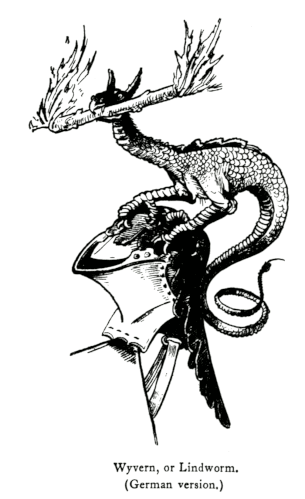 The story of "Prince Lindworm" or "Kong Lindorm" is ATU 433B, related to the Animal Bridegroom tale family. Many variants of the Animal Bridegroom story feature serpents, but this one is rather unique. And upon researching it, I soon learned that pretty much everything I knew about this story was wrong.
A lindworm is a dragon usually shown with just two legs, often seen on coats of arms. Although the stories are very different, "Prince Lindworm" begins with a scene almost identical to the start of "Tatterhood." In both, a queen who wants a child encounters an old woman who gives her instructions on getting one. Tatterhood's mother pours water beneath her bed, and the next morning finds a lovely flower and an ugly flower there. Lindworm's mother places a cup upside-down in her garden, and the next morning finds a white rose and a red rose underneath. In both cases, there's a warning. Tatterhood's mother is instructed not to eat the ugly flower, while Lindworm's mother is told to pick only one (red for a boy, white for a girl). But both are overcome by temptation, because the first flower "tasted so sweet" - the same reason in both versions. This hunger and greed symbolizes sexual temptation. It also hearkens to myths that blamed women for birth defects - like "maternal impression," the idea that the mother's thoughts or surroundings could influence her unborn child. For Tatterhood, a connection seems clear: Tatterhood's pretty twin is created by the beautiful flower, and the outwardly repellent Tatterhood by the foul-looking plant. The twins are fundamentally opposite, yet love each other deeply. The same motif drives "Biancabella and the Snake," an Italian tale by Giovanni Francesco Straparola, where a woman gives birth to a baby girl with a snake around her neck. The snake, Samaritana, serves as a supernatural helper to her human sister, Biancabella. She eventually doffs her serpent skin and becomes a woman without explanation. (Italo Calvino collected a folktale, "The Snake," with the same story - except that the snake is merely a helpful animal, not an enchanted sibling.) In the opposite of these tales with diametrically opposed siblings, there are stories where two women eat of the same food and bear identical children. You find this in the Italian "Pome and Peel" and the Russian tale of "Storm-Bogatyr, Ivan the Cow's Son." In "Ivan the Cow's Son," rather than a woman giving birth to an animal, a cow gives birth to a human. But Prince Lindworm apparently follows a different internal logic. The queen is hoping to have both a son and a daughter when she eats both roses; this makes sense, even though it's incredibly stupid to disobey instructions in a fairytale. In fact, she eats the white rose first, so you would think she would have a daughter first. However, what she gets is a male lindworm and a baby boy - twins, as in "Tatterhood" or "Biancabella," one perfect, the other monstrous. The lindworm baby escapes and is not seen again until, years later, the second prince prepares to marry. The lindworm returns; as he is firstborn, he says he should get married first. The royal family obtains a bride for him, but the lindworm eats her on their wedding night. Before you know it, we're on Bride #3, and she quickly deduces that this isn't going to end well for her. However, an old woman gives her advice. Bride #3 is savvier than the queen and follows the instructions exactly. On her wedding night she wears ten white shifts and tells the lindworm to shed one skin every time she takes off a layer of clothing. Once he's removed nine skins, there's nothing left of him but a mass of bloody flesh. She beats him with whips dipped in lye, then bathes him in milk, and finally takes him in her arms. When people come to check on them the next morning, they find her sleeping beside a handsome human prince. Marie-Luise von Franz interpreted the lindworm as a "hermaphrodite": “a masculine being . . . wrapped up in the feminine or the dragon skin. . . . Prince Lindworm is also a man surrounded by the woman, but he is in the form of a lump of bleeding flesh surrounded by a dragon skin, a regressive form of the union of the opposites.” In alchemy, according to von Franz, hermaphrodites are closely connected to dragons and serpents. This explanation fails for me. The white rose was eaten first. Surely the feminine element should be at the center of the lindworm's being? What makes scales feminine and blood masculine? The biggest stumbling block is the existence of the twin brother. Why wasn't he affected? Going by the opening scene, it seems to me, the lindworm should either be a princess or have an older sister. Taking a step back: the motif of the enchanted prince removing his animal skin is familiar. In "Hans My Hedgehog," a couple wishes desperately for a child, but their son is born as (wait for it) a hedgehog. He tries several times to take a bride, but the first girl is unwilling and he stabs her with his prickles. The second is willing, and on their wedding night he removes his hedgehog skin to become a handsome man. The same thing happens in the Italian "The Pig King." Both stories are Aarne Thompson type 441, the hog bridegroom. Very often this tale includes a number of false starts to marriage, where the enchanted bridegroom turns horrifyingly violent towards the maidens who reject him. The removable skin seems more appropriate for serpents, which really do shed their skin, and which in many cultures are symbols of rebirth and transformation. And there is a widespread tale type of snake and serpent husbands, type 433C. Prince Lindworm is unusual in that he must remove multiple skins. His transformation is more involved than these other examples. He must also be whipped and bathed. The act of bathing suggests baptism, and thus forgiveness of sins and rebirth. (And he needs that forgiveness of sins after all that snacking on maidens.) It's a little more odd that he is bathed in milk. However, there's a widespread tradition of offering milk to snakes. In Hinduism, milk is offered to snake idols, for instance on the feast of Nag Panchmi. So you get Indian folktales like "The Snake Prince," where in order to restore her husband from his serpent form, the heroine must put out bowls of milk and sugar to attract all the snakes and gain an audience with their queen. According to Arthur Evans, a similar tradition of milk offerings for "household snakes" existed in Greece, Dalmatia and Germany. Marija Gimbutas said that this practice persisted in Lithuania up into the 20th century. Snakes actually can't digest dairy products and do not drink milk unless suffering from dehydration. In the Turkish tale of "The Stepdaughter and the Black Serpent," the heroine serves as a nursemaid for the serpent prince. When he's an infant, she keeps him contained in a box of milk. When he leaves the box, she beats him with rose and holly branches to deter him from hurting her. He eventually wants to take a wife, but kills forty (!) brides one after another. The heroine, chosen as his bride, wears forty hedgehog skins and asks the snake to remove one skin every time she does. After removing forty snake skins, he is left as a human and they burn the snake skins.It's the same tale as Prince Lindworm, except that the order of events is different. There's also no twin brother to complicate things. "The Stepdaughter and the Black Serpent" was recorded long after Prince Lindworm, but what if it's closer to the original form of the story? I began to wonder if the opening scene and the twin brother were foreign to the essential tale. They certainly do not appear in most variants of the tale type. The Animal Bridegroom, which often begins with the desire for a child, could easily have been combined with similar stories like Tatterhood or Biancabella. The twin brother/missing sister problem would then exist because that element was added later. Soon after, I learned Prince Lindworm's true origins. Most modern sources call it Norwegian, but it's actually Danish. It was collected in 1854, and the original version is very different. D. L. Ashliman did an English translation. In the oldest version of "Kong Lindorm," the queen eats both roses, but has only one child - the lindworm. There is no twin brother. Marie-Luise von Franz's premise finally begins to make sense! The story otherwise proceeds roughly as I knew it, but there is a second half that was completely new to me. Now happily married to the former lindworm, the heroine gives birth to twin boys, but an enemy at court gets her exiled. She uses her own breast milk to disenchant two more cursed men (King Swan and King Crane), before her husband finds out what happened and retrieves her. "Kong Lindorm" was first published by Svend Grundtvig in Gamle danske Minder i Folkemunde (1854). A Swedish version, "Prins Lindorm," was published in 1880. This was a very close retelling of the first version, with one important difference: the opening. This time, the queen is given instructions for bearing twins, no mention of whether they will be male or female. She is supposed to carefully peel the two red onions she grows, but she forgets to peel the first one. Storytellers might have added the twin brother because they confused this story with Tatterhood, which - as previously mentioned - has a strikingly similar beginning. Then a variant appeared in Axel Olrik's Danske Sagn og Æventyr fra Folkemunde (1913). This was almost identical to the first Kong Lindorm, except that it included the twin brother. However, the storyteller did not otherwise alter the opening, so the birth of twins made no sense. The second half was hacked off, perhaps because the writer didn't want to talk about breast milk, and also because that's where the story starts to drag. This short version was translated into English in 1922, in a book titled East of the Sun and West of the Moon: Old Tales from the North. There, it was thrown in alongside Norwegian stories collected by the famous Asbjornsen and Moe, leading to the confusion around its origins. So there you have it. The version I knew had been simplified and altered. Ultimately, the story's sense of confusion stems from careless editing and a misunderstanding of the tale's logic. Adding in a second child obscures the idea of the older tale. In fact, the white rose leads to a daughter, a red rose leads to a son, and both roses together make a giant dragon monster. Simple, right? Okay, I think it's really about 19th-century sexual mores for women. The queen's intemperance leads to a curse which affects her unborn child and generations to come. She hungered for extra roses (read: she was lustful), so her child is neither man nor woman and can't have a normal marriage. Echoing his mother's method of conception by eating, the only way he can engage with a woman is by devouring her. And his wives die because they are not behaving correctly on the wedding night. When Bride #3 follows proper instructions, she redeems her husband and can look forward to a happy and fruitful marriage. Note that she is still wearing one shift by the end of the cursebreaking ritual, indicating modesty and chastity. This is different from the Indian version, where the girl and the serpent shed the same number of skins. There's also an Oedipal note to it; she must bathe him in milk in order for him to be reborn. That original maternal sin has to be corrected. The longer version even doubles down on the milk motif. You can read a translation of the original version here, and the popular English version here. Further Reading
 Have you ever wondered how you say "Prince Charming" in other languages? In several Romance languages, the term translates to "The Blue Prince" and is a common term for the perfect man. There's the "príncipe azul" (Spanish), "príncep blau" (Catalan), "principe azzurro" (Italian), and "prince bleu" (French). In all cases, the idea translates to what an English-speaker would call a Prince Charming or a knight in shining armor. Variants of this term go back at least to the 18th century.
Zadig ou la Destinée by Voltaire (1747) features a joust in which the hero Zadig wears white armor and defeats a man in blue armor, who is referred to briefly as "le prince bleu." This is only a passing line, but one wonders if it was a reference to a well-known phrase. Sur la scène et dans la salle. Miroir des théâtres de Paris (1854) describes a play featuring the role of "prince Azur" (p. 46). The Revue de France in 1879 mentions "le prince bleu des contes de fées." Victor Hugo's Les quatre vents de l'esprit (1881) has "le prince Azur" (p. 252). "Le prince Bleu" and "roi Charmant" (King Charming) both get a mention in Jules Claretie's Noris: mœurs du jour (1883, p. 37). In Contes populaires de Basse-Bretagne by Francois-Marie Luzel (1887), a character in the tale of "Le Prix des Belles Pommes" is called Le Prince-Bleu. He is the hero's strongest rival for the princess's hand, but receives a dismal fate while the despised hero triumphs. By 1893, La Union literaria defines "Príncipe Azul" as a character "de una mitologia fastidiosa ser inverosimil y aereo" (of an annoying mythology, improbable and airy). This isn't even close to an exhaustive list. Oddly enough, in quite a few of these examples, the blue prince gets set up as the classic knight in shining armor, but is either disparaged as a foolish idea by the narrator or given a comeuppance by the story. So why "blue"? Apparently there has been some speculation that King Vittorio Emanuele III of Italy was the original for the Blue Prince. Blue was the traditional color of his family, the House of Savoy. An article by Paolo Zollo was titled "Che il Principe Azzurro sia stato Vittorio Emanuele?" (Was the Blue Prince Vittorio Emanuele?) in Messaggero veneto (1982). A connection had been drawn previously by Giovanni Artieri, who described Vittorio's wife Elena as "Cenerentola" (Cinderella) and Vittorio as "un Principe Azzurro, azzurro Savoja" - "a Blue Prince, Savoyan blue." (Il tempo della Regina, 1950, p.52). Unfortunately for this theory, Vittorio and his wedding (which seems to have inspired the comparison) are a bit late. One possibility is that "the blue prince" comes from the idea of blue-blooded royals. Blue-blooded has long been a way to refer to the nobility. The nickname is derived from the Spanish "sangre azul" dating at least to 1778. It was theoretically inspired by the nobility, with their fair skin that showed off blue veins. Or the prince might literally be wearing blue. Blue pigment was expensive in the past and often marked the clothing of the nobility. The Oxford English Dictionary lists a number of uses of the term "royal blue," including an advertisement in the 1782 Morning Herald & Daily Advertiser: "Among other colours are the royal blue, the green, pink, the Emperor's eye, straw, &c." Similarly, there is a 1787 reference to a sky "of the deepest royal blue." There are a multitude of possible explanations for the "blue prince" term. According to this forum thread, one Hungarian term for a Prince Charming is "kék szemű herceg," or the blue-eyed prince. So depending on how you look at it, the term could be a reference to blue blood, blue clothing, blue eyes, or something else entirely. Whichever the case, those three things all accentuate the relevant traits of the archetypal fairytale prince. He's royal, rich, and good-looking. All the same, it seems writers had tired of this ideal even in the 19th century, disparaging the character as unrealistic or showing a less promising hero who defeats him.  Hans Christian Andersen's tale of "The Marsh King's Daughter" (1858) follows Helga, the daughter of a monster and a kidnapped princess. During the day she is beautiful like her mother but violent and cruel; during the night, she is hideous like her father but sad and gentle. There are heavy Christian themes, with Helga meeting a noble missionary priest and breaking free of her curse through the power of God. At the end, Helga and her mother return to Egypt. Helga is about to be married to a prince, but seems distracted from her impending wedding. She has spent a lot of time meditating on Christianity and the now-dead priest who saved her. She prays for a glimpse of Heaven and is allowed to see its glory for three minutes. When she returns, however, she learns that "many hundred years" have passed since she vanished on her wedding day. Upon hearing this, her body crumbles to dust, freeing her to return to Heaven.
This story always pulled me in at the beginning with its concept and descriptions, but the ending was just depressing. Yes, Helga’s greatest desire is to go to heaven, but I still found the ending dissatisfying and discomfiting. There's just something freaky about your heroine going all Infinity War at the end. And I say this as someone who grew up loving stories of martyrs and saints. Andersen, as usual, pulled in a lot of fairy tale concepts. The beginning is very familiar, with a group of swan maidens taking off their feathery cloaks to bathe, and a man who captures and forcibly marries one of them. However, this trope usually features a human man winning a supernatural bride. In this case, the swan maidens are human princesses and the man is a literal swamp monster. And the ending of Helga's story is a popular medieval legend. In fact, that legend is a fairy motif repackaged by Christian storytellers. This motif has been incredibly widespread from ancient times up to modern literary tales like Rip Van Winkle. Urashima Tarō, a Japanese tale dating back to the 8th century, centers around a fisherman named Urashima who catches a turtle which turns out to be a princess of the sea. She takes him away to her blissful underwater kingdom, where he has eternal life and everything he could ever want. What he wants, though, is to visit his old home on land. He arrives only to find that centuries have passed and everything he knew is gone. The ending varies, but generally all of his years come upon him at once and he is left an old man, his immortality gone. And in The Voyage of Bran from Ireland, also from around the 8th century, much the same thing happens. After seeing a beautiful silver branch, Bran sets out for the Land of Women, the utopian island where the branch grew. He and his men live there for what seems like a year, feasting and totally happy, but one of them feels homesick. The band returns to Ireland briefly, and learns that centuries have passed and they are remembered only as legends. The homesick man steps onto dry land and turns to dust, and his companions decide they'd better book it back to the Land of Women. King Herla, an English character from the 12th century, had the same experience after dealing with a dwarf king. And in a 12th- or 13th-century lai, the knight Guingamor (just like Urashima and Bran) immediately regrets leaving his supernatural sweetheart. The moral in Urashima and Bran's tales is to not break taboos. In both cases, a man ignores the commands of his lover (who is basically a goddess) and dooms himself to a terrible punishment. King Herla's post-Christian story has the moral that the supernatural creatures of older religions are treacherous and evil. Herla is punished for having anything to do with the fae. In medieval times, the story got repurposed. The land of joy and immortality was replaced by a Christian Paradise. Often, the hero of this story was a monk or bishop. The story was used to illustrate the idea that Heaven is so wonderful that a thousand years there are like three minutes, and earthly life is nothing compared to it. The main character would return long enough for people to confirm his identity and be amazed by the miracle, before he disintegrates and joyfully returns to Heaven for good. The main idea of the story is that eternity will not be boring, an issue which has apparently nagged at people for a long time. Versions appeared in English, Spanish, Slovenian, you name it. A fourteenth-century Italian legend featured four monks who, like Bran, went off seeking Paradise after finding a wondrous tree branch from that location (MacCulloch, Medieval Faith and Fable, p. 199). The most widespread version, where a bishop is entranced by the song of an angelic bird, appeared in a homily by the 12th-century French bishop Jacques de Vitry. At the same time, interestingly, the story has survived with fairy roots intact. For instance, a Welsh story of a farmboy who sits under a tree listening to a bird’s entrancing music parallels the story of the bishop. Despite the similarities, it's clear that the bird in the Welsh fairytale is from a very different otherworld than Heaven. (Howells, Cambrian Superstitions) Hans Christian Andersen may have been particularly inspired by something close to home: the Danish tale of "The Aged Bride." Published in Benjamin Thorpe's Northern Mythology (1851), it follows a bride who steps out of a dance at her wedding and notices elves celebrating in a nearby field. When she approaches, they offer her wine and invite her to join in their dance. Completing the dance, she remembers her husband and hurries home. There, however, she finds herself in a situation identical to Helga's, Urashima's, and Rip Van Winkle's. The wedding party has vanished and the town looks completely different. No one recognizes her except as an old story from a hundred years ago. Upon hearing this, she falls down dead. Compared to this story illustrating the dangers of the fairy world, "The Marsh King's Daughter" is positively cheery. Further Reading
|
About
Researching folktales and fairies, with a focus on common tale types. Archives
April 2024
Categories
All
|
Writing in Margins
 RSS Feed
